


Large Slabs:
Basic Processing Flow for Large Slabs:
Material Selection → Sawing → Drying → Back-Netting → Resin Filling → Grinding & Polishing → Packaging → Warehousing.
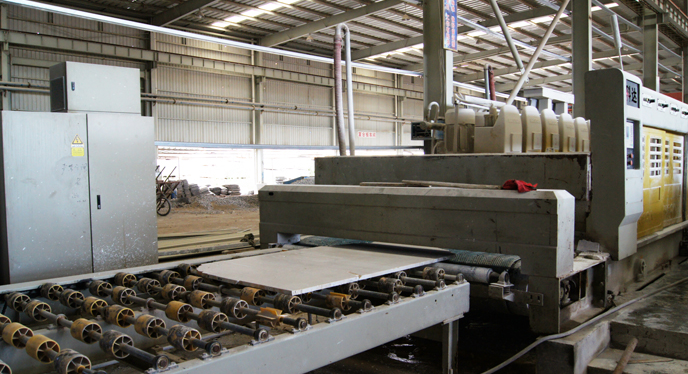
(Stone Slab Grinding and Polishing)
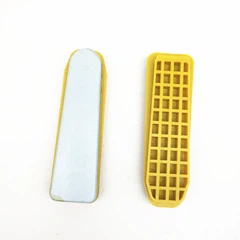
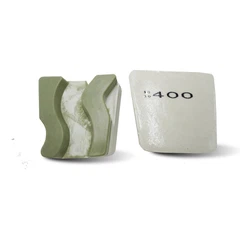
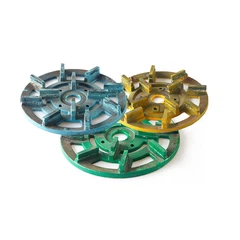
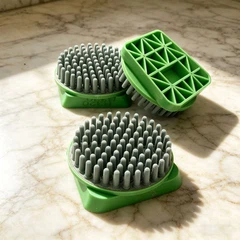
Our company specializes year-round in the R&D and manufacturing of abrasives and grinding tools for the grinding and polishing of large stone slabs, offering superior performance and excellent cost-effectiveness.
Note: The primary equipment used for sawing marble includes frame saws and sand saws. The key difference is that frame saws utilize saw blades equipped with cutting teeth, whereas sand saw blades lack teeth; instead, they rely on the abrasive friction of silicon carbide grit-mixed into the cooling water-to perform the cutting. Back-netting is primarily applied to large marble slabs because marble often contains latent fissures, possesses lower inherent strength, and is prone to breakage; the back-netting process therefore serves to reinforce the material's structural integrity. Resin filling (or "scraping") on the slab surface is performed to fill voids and pores within the stone; simultaneously, the resin penetrates deep into the material, resulting in a superior surface gloss and enhanced structural strength after grinding and polishing. The grinding and polishing equipment-variously referred to as an "automatic polisher" or "polishing line"-varies by manufacturer, typically featuring configurations ranging from 14 to 20 polishing heads. A sequence of abrasive pads, ranging from the coarsest to the finest grades, is arranged in succession along an automated conveyor line, allowing the raw slab to be transformed into a finished, polished slab in a single, continuous pass.
Certain types of granite may also undergo back-netting if their structural strength is deemed insufficient; additionally, to conceal defects such as surface voids or hairline cracks, resin filling and patching may also be applied to the granite slab's surface.
IProject Slabs
Basic Processing Flow:
Material Selection → Layout Planning → Cutting → Pattern Matching → Repair & Patching → Machining → Grinding & Polishing → Quality Inspection → Packaging → Warehousing.
Material Selection & Layout Planning: Since material requirements-including specifications and aesthetic characteristics-vary significantly from one construction project to another, and given the natural color variations inherent in stone, a rigorous selection and planning process is essential prior to production. This process aims to ensure the desired aesthetic outcome for the project while simultaneously maximizing the material yield rate. It involves carefully screening materials based on their dimensions and visual patterns (e.g., determining which specific colors are best suited for particular sections of the project, or identifying which dimensional combinations will result in the most efficient material utilization) in order to effectively meet project requirements and facilitate cost control.
2. Cutting: In this stage, the raw stone slabs are cut into specific dimensions in strict accordance with the project's architectural drawings. A critical aspect of this process is "nested cutting"-the strategic arrangement and cutting of various required dimensions from a single slab. The efficient combination and utilization of different size requirements during this stage directly determine the overall material yield rate.
3. Layout: This refers to the preliminary arrangement of materials for installation across various sections and decorative surfaces of a project, based on engineering drawings. This process allows for better control over the final aesthetic outcome once installation is complete, while also facilitating the repair and treatment of any defects found on the slabs, thereby ensuring the decorative finish achieves its optimal effect.
4. Machining: To enhance the decorative impact of the project-particularly regarding stone wall cladding-the edges of the slabs are often processed into various shapes. To boost both work efficiency and product quality, specialized machinery is utilized to execute these edge profiles (e.g., chamfering, grooving, decorative profiling, etc.).
5. Grinding and Polishing: While distinct from the grinding and polishing applied to raw slabs, the underlying principle remains the same: utilizing various grades of abrasives to smooth and finish the areas of the slab that have undergone machining. This process is essential for achieving the desired decorative finish. (Note: This stage is predominantly a manual operation requiring a high level of technical skill. The primary tool used is a handheld grinder, equipped with various polishing pads to smooth and polish the rough surfaces created during the machining process.)
Waterjet Mosaic
Basic Process:
Material Selection → Programming → Cutting → Assembly & Bonding → Grinding & Polishing → Trial Assembly → Packaging → Warehousing. This product is created by using a waterjet machine to cut materials precisely according to design drawings; the various pieces-differing in size, shape, and color-are then assembled and bonded together to form the final product.
1. Material Selection: To achieve the optimal natural aesthetic for the product, materials must be carefully selected based on the specific color palette and grain patterns required by the mosaic design-a step that is particularly critical for designs featuring realistic or simulated imagery.
2. Programming: Since the waterjet cutter is a fully automated, computer-controlled system, the cutting paths for the product must be programmed in advance. Only after this programming is complete can the machine proceed to cut the materials according to the specific requirements of the design.
3. Assembly and Bonding: The individual components of the mosaic are assembled according to the design pattern. This process ensures that all joints (seams) between the pieces are consistently fine and uniform. Adhesive is then applied to all gaps to bond the various components together into a single, cohesive unit.
4. Grinding and Polishing: Because adhesive is used to fill all the joints, residual glue often remains on the surface of the product. Additionally, due to slight variations in the thickness of the stone slabs, the entire surface must undergo a final grinding and polishing process to ensure perfect flatness and a smooth finish.
5. Trial Assembly: This process applies specifically to large-scale mosaic patterns. Due to constraints related to structural integrity, packaging, and transportation, exceptionally large mosaics are typically processed and shipped as separate components. To ensure a successful installation outcome at the job site, it is mandatory to conduct a trial assembly of all major components prior to the product leaving the factory, thereby guaranteeing a smooth installation process on-site.
Special-Shaped Products
1. Moldings/Profiles: Slab Cutting - Component Separation - Layout & Numbering - Profiling - Joining & Polishing - Packaging - Warehousing
1.1 Slab Cutting: The process of sawing raw stone blocks into slabs suitable for molding products.
1.2 Component Separation: The process of cutting the raw slabs into individual pieces according to the specific dimensions and specifications of the molding products.
1.3 Layout & Numbering: To ensure that the stone's grain flows naturally and color transitions are seamless, the raw molding pieces must be laid out and numbered *before* profiling begins, thereby preventing unnecessary material waste.
1.4 Profiling: Utilizing photoelectric technology, this process shapes the raw stone pieces to match the specific contours and designs detailed in the engineering drawings.
1.5 Joining & Polishing: Since the surface of products processed by profiling machines is initially quite rough-failing to reveal the stone's natural color and grain-the profiled pieces must undergo polishing. Additionally, to ensure dimensional consistency after installation and to guarantee smooth, seamless joints, the individual pieces must be fitted and joined together.
Columns:
Hollow Columns, Solid Columns
2.1 Hollow Columns
2.1.1 Curved Panels: Material Selection - Block Cutting - Wire Saw Curving - Grinding & Polishing - Edge Trimming - Layout & Numbering - Packaging - Warehousing
2.1.2 Capitals & Bases: Material Selection - Block Cutting - Wire Saw Curving - Component Separation - Layout & Numbering - Shaping - Grinding & Polishing - Dry Assembly (Test Fit) - Layout & Numbering - Packaging - Warehousing
Block Cutting: The process of cutting raw stone blocks into sections based on the required height of the final product, thereby maximizing material utilization and processing efficiency. Wire Saw Curving: Utilizing CNC wire saws, this process cuts the raw stone blocks into specific curved shapes according to the product's design specifications. Component Separation: Since column capitals and bases are typically much shorter in height than the main column shaft, they are often cut simultaneously from the same block (gang-cut) based on material availability, and then separated into individual components to boost production efficiency.
Countertops
Basic Process: Material Selection - Slab Cutting - Color Matching - Edge Lamination (Thickening) - Edge Profiling - Cutouts/Hole Drilling - Grinding & Polishing - Packaging - Warehousing
Carving
Basic Process - Material Selection - Blank Cutting - Drawing Preparation - Rough Carving - Trial Assembly - Fine Carving - Grinding & Polishing - Packaging - Warehousing
We will conclude our overview of the common processing workflows for stone products here. If you are also involved in the stone processing industry, we invite you to stay in touch with our company; Cheefung supply abrasives and grinding tools for stone processing year-round.