



Engineered quartz is a type of man-made stone containing resin; it is not heat-resistant and is commonly used for kitchen countertops. Quartzite is a natural stone; it is heat-resistant but brittle, and is often used for outdoor architectural decoration. So, how can one distinguish between the two with the naked eye?
In English, the term "quartz" is typically used for engineered quartz stone, while "quartzite" refers to natural quartzite.
I. Core Fundamental Differences
- Engineered Quartz: Fully known as engineered quartz stone, this is a synthetic slab material. It uses quartz sand and quartz powder as the primary aggregates (accounting for about 90%), combined with unsaturated resin, curing agents, pigments, and other additives. It is produced through vacuum pressing and high-temperature curing. Its defining characteristic is the inclusion of synthetic resin.
- Quartzite: A natural metamorphic rock formed from quartz-rich sandstone through high-temperature and high-pressure metamorphism within the Earth's crust. It typically contains over 85% quartz minerals, involves no synthetic manufacturing processes, and contains no resin.
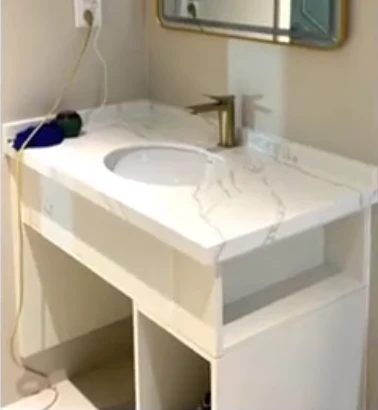
(The bathroom countertop is made of quartz stone)
II. Differences in Everyday Applications
1. Indoor Countertops
- Engineered Quartz: The most popular choice for kitchen cabinet countertops and bathroom vanities. It has a dense structure and extremely low water absorption, making it resistant to the penetration of everyday grease and water stains. It requires no periodic sealing or maintenance and is easy to clean. Its downside is that the resin content makes it non-heat-resistant; scorching hot cookware cannot be placed directly on the surface.
- Quartzite: Used only sparingly for kitchen islands and bathroom countertops in high-end residences; it is a niche, premium option. While the natural material offers excellent heat resistance, it contains natural micro-fissures that allow grease and colored liquids to seep in easily. It requires regular application of protective sealants and is rarely chosen by the average household.
2. Outdoor Applications
- Engineered Quartz: Completely unsuitable for outdoor use. Prolonged exposure to UV rays causes the resin component to age rapidly, yellow, and become brittle or crack; it is strictly for indoor use.
- Quartzite: One of the primary natural stones used for outdoor decoration. It boasts exceptional weather resistance-withstanding wind, sun exposure, and freeze-thaw cycles-and is commonly used for exterior dry-hanging wall cladding on villas, courtyard paving, outdoor bars, and decorative landscape stone.

(Natural quartzite is used for the construction of high-end hotel lobbies)
3. Commercial and Public Sectors
- Engineered Quartz: Widely used for public washbasins, bar counters, and reception desks in shopping malls, hotels, and office buildings, as well as food preparation counters in restaurants. It offers stable bulk supply and minimal color variation, making it ideal for standardized fit-out requirements.
- Quartzite: Primarily used for wall and floor decoration in high-end commercial spaces. It is prized for its unique natural texture, though its overall usage volume is far lower than that of engineered quartz.
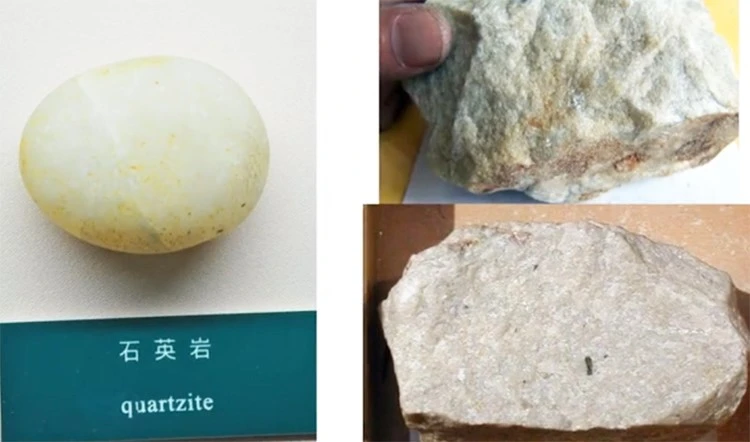
(Appearance of natural quartzite)
III. Quick Visual Identification Methods
1. Observe Pattern Repetition and Color Variation
This is the most intuitive method of assessment:
- Engineered quartz patterns are artificially formulated; the texture and particle distribution of a specific product are highly uniform and consistent. When multiple slabs of the same model are joined, obvious pattern repetition is visible, and there is virtually no overall color variation.
- Quartzite textures are formed entirely by natural geological processes; the veining and color of every slab are unique. Natural color variations and banding exist, and the stone may contain inclusions of natural minerals like mica or feldspar-no two slabs are ever identical.
2. Examine the Cross-Section and Bonding Texture
If a broken edge or cut cross-section is visible:
- The cross-section of engineered quartz reveals traces of quartz particles bonded by resin. The surface is relatively fine with a slight resinous sheen; the bonding between particles is evident, and it lacks the jagged, brittle fracture typical of natural rock.
- The cross-section of quartzite displays the brittle, jagged fracture characteristic of natural rock. It is rough and granular, completely lacking the sheen of resin bonding, and exhibits the pure texture of natural stone.
3. Observe Surface Gloss and Particle Distribution
After polishing, the surface of engineered quartz has a uniform, soft luster. Particle sizes and distribution are regular, offering the consistent, uniform texture typical of an industrial manufactured product. When polished, quartzite exhibits a luster resembling the vitreous quality of natural crystals; it features uneven grain sizes, localized reflections from mineral crystals, and may contain subtle natural mineral veins or faint internal markings.
4. Simple burn test for assessment (perform on an inconspicuous corner; non-destructive)
Use an ordinary lighter to heat an inconspicuous corner of the slab for about 10 seconds:
- Engineered quartz will show signs of yellowing or charring that cannot be wiped off after cooling (due to the resin charring from the heat).
- Quartzite shows no significant change after heating and returns to its original state after wiping.