



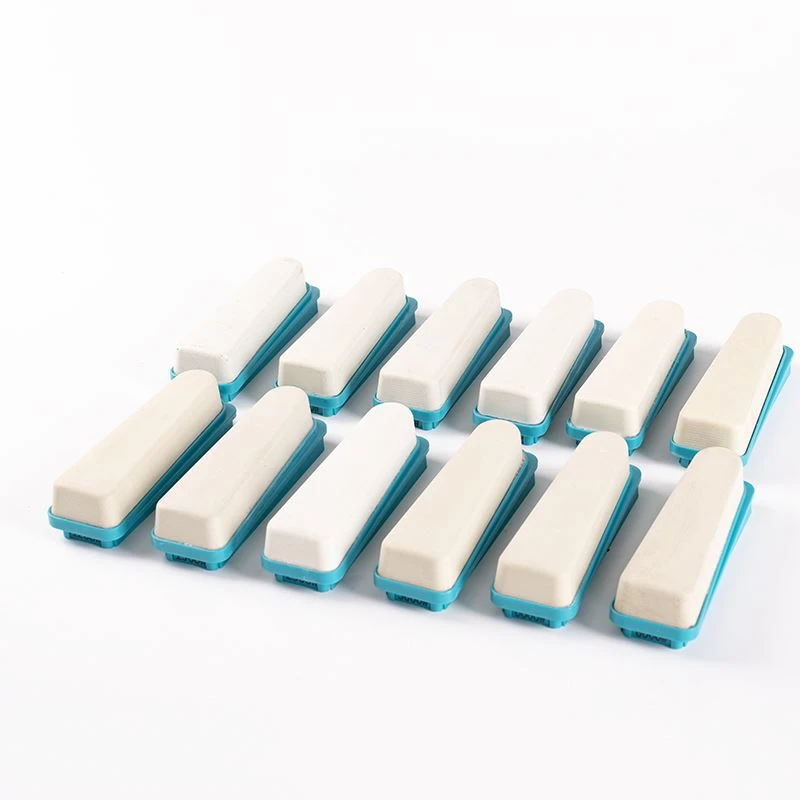
Engineered Quartz · Line Polisher Abrasives
Resin Bond Diamond Fickert for Engineered Quartz Slabs
The working section of a quartz polishing line - from 300# to BUFF - in bond families matched to the slab body you actually run. Typical result: 50–70 gloss units at 60°, held evenly across the face. 3,000–8,000 m² per set depending on grit station.
- Format
- L140 / L170Standard fickert block
- Grit range
- 300# – BUFF7 grades + buff
- Typical gloss
- 50–70 GUAt 60°, on standard bodies
- Service life
- 3,000–8,000 m² / setBy grit station
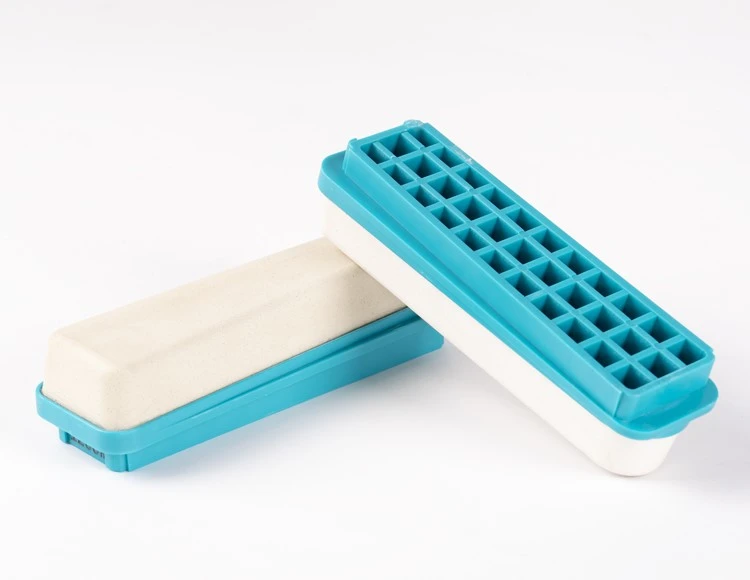
Diamond Fickert for Engineered Quartz Slab
01 - Where this tool sits on your line
A quartz slab is not polished by one product
Four stations, four different jobs. The first two remove geometry and depth. The last two build the surface. A resin bond fickert owns the last two - and only the last two.
Calibration & coarse grinding
Gauge marks and saw lines come off. Metal bond diamond.
Intermediate grinding
Deep scratches refined. Magnesite or soft metal bond.
Fine grinding & polish
Scratch pattern replaced step by step. Gloss builds here.
RESIN FICKERTBuff / final gloss
Last remnant softened. No cutting left to do.
RESIN BUFFThe resin section begins where the surface stops being a geometry problem and becomes an optical one. Everything upstream of that point is somebody else's tool - and if it was not done, this page will not pretend a fickert can undo it.
02 - Specification
Product data
The figures below are the working range for this product family. Bond hardness, segment geometry and working height are set against your line after a trial - not picked off a shelf.
Gloss and life figures are typical for the product family under normal operating conditions. They are not a performance guarantee: final gloss is set by the slab body, the calibration tolerance and the condition of the upstream stations as much as by the abrasive.
03 - Why a quartz line needs its own fickert
Four differences that change the tool
A granite fickert and a quartz fickert look the same on a bench. On a line they behave nothing alike. These are the four reasons why.
Two minerals wearing at two rates
Quartz aggregate sits at Mohs 6–7. The glass and crystal chips used in translucent and crystal bodies sit around 5.5. Under the same head, the softer component wears away first. A grit progression tuned purely for quartz will leave chips standing proud or sitting in shallow dimples - the sparkle reads as a pattern of dents instead of points of light.
On a crystal body the sequence has to be graded by the softer component. That costs a little line speed, and there is no way around it.
The binder is resin - and heat lands on it
An engineered slab is a composite: roughly 90–94% quartz held in 6–10% polymer resin. Friction at a polishing head does not heat the quartz - it heats the resin in the slab. Hold a head in one place, or run a bond that is too hard for the speed, and the surface turns from glossy to a dull grey haze that no cleaner will remove.
This is why the resin section needs a bond that cuts cool, not a bond that cuts hard.
Colour is a proxy for resin content
Pure white and solid black bodies typically carry more resin and finer aggregate at the surface. White reflects every yellowing mark and every haze patch. Black reflects everything. Large-particle and veined designs are far more forgiving - the pattern hides what a solid colour exposes.
So "the same fickert for every colour" is a decision that quietly costs scrap rate, not one that saves money.
Polishing refines a surface, it cannot flatten one
A polishing head removes a roughly fixed depth of material as the slab passes - on the order of 8–15 µm per head. It follows the geometry it is given. If calibration left a wave in the thickness, the polish reproduces that wave faithfully as a soft band across the face.
A slab with wavy reflections is a calibration defect. No abrasive sold on this page will change that, and any supplier who says otherwise has not spent time on a line.
04 - Bond families
Match the bond to the body, not to the catalogue
Resin bond hardness is the single variable most often sold as "one size fits all". It is not. We build four families, and the right one is decided by the slab you polish - which usually becomes obvious within one trial slab.
White / Super White
Softer bond, lower cutting energy. The surface has the most resin and the least aggregate, so it burns first and shows haze most.
Watch: never run white on a bond selected for veined material.
Dark / Black
Gloss differences read at a glance on dark bodies, so uniformity matters more than peak number. Bond is tuned for a clean, streak-free cut.
Watch: scratches show as clearly as haze does. Do not over-pressure to chase gloss.
Crystal / Glass-chip
Sequence graded by the softer component so chips finish level with the quartz rather than proud or recessed.
Watch: a quartz-only sequence shows up as dimples around each chip.
Standard / Veined
The general-purpose family, and the default for a first trial on a line we have not seen before.
Watch: still worth confirming on white and black before a full-line order.
Naming and grouping are ours; the logic is not. Every quartz producer we work with ends up running at least two bond hardnesses across their colour range, whether they planned to or not.
05 - Life and real cost
Price per block is not the number that matters
Two fickerts can cost the same per block and be 40% apart in cost per square metre of slab. The difference is service life and how often the line stops.
The second cost that never appears on a quotation is the stop. Changing a set means the line halts, heads are re-dressed, pressure is re-set, and the first slab is usually scrap. A block that lasts 40% longer is worth more than 40% of its price once you count that.
06 - Reading a bad slab
What the surface is telling you
Most of the "abrasive problems" we are asked to quote for are not abrasive problems. The surface usually identifies its own cause - and its own responsible station - before anyone needs to open a box.
Fine directional haze, visible only against a window at a low angle
What is actually happeningA grit step was skipped. The finer head polished the plateaus but never reached the floor of the deeper grooves.
Responsible stationPolishing
Can a fickert fix it?Yes - re-run the correct sequence
Dull grey patch with soft edges
What is actually happeningThe resin in the slab itself was overheated by a head that dwelt in one place, usually a conveyor hesitation or a manual touch-up.
Responsible stationPolishing
Can a fickert fix it?No - re-polishing usually enlarges it
Soft waves in the reflected light across the face
What is actually happeningThickness variation carried through from calibration. Polishing removes a fixed depth, so it reproduces the wave rather than removing it.
Responsible stationCalibration
Can a fickert fix it?No - geometry cannot be polished flat
Scattered fine dark specks across the face
What is actually happeningAir voids that survived the vacuum press. A few tenths of a millimetre across, invisible on a matte surface, obvious on a polished one.
Responsible stationPressing
Can a fickert fix it?No - the voids are inside the body
Chains of shallow dimples around each crystal chip
What is actually happeningThe grit progression was tuned for quartz hardness, not for the softer glass chip, so the chips wore down faster than the surrounding grain.
Responsible stationPolishing
Can a fickert fix it?Partly - re-run with a graded sequence
Gloss varies 5 GU or more between slabs of the same batch
What is actually happeningUneven block wear, uneven head pressure, or a bond batch that drifted. Rarely the slab.
Responsible stationPolishing
Can a fickert fix it?Yes - fresh blocks plus a pressure check
07 - Fitting and first run
What we need before we can specify the bond
The fickert format is standard. The head it mounts into is not. Head taper differs between machine builders - a block that fits one builder's head will sit differently in another's, and a poor seat shows up as chatter, uneven wear and a gloss streak.
-
Machine brand and model
Breton, Simec, Pedrini, or a domestic continuous line. Head taper is confirmed against this.
-
Number of polishing heads
Twelve, sixteen, twenty-one - this decides how many grit steps the sequence can afford and where the resin section begins.
-
Blocks per head
Usually six, eight or ten per plate. It sets the per-head cost and the load on each block.
-
Line speed (m/min)
Slower belt means longer dwell and higher gloss - but faster resin consumption. This is the figure most buyers leave out and the one that changes the bond most.
-
Colour range and slab thickness
Which bodies you run most, and in what proportion. A line that runs 70% white needs a different starting bond than one that runs veined material.
08 - How a trial works
Four steps, one slab, one honest number
Bond hardness cannot be chosen from a product name. It is set by running blocks against your material on your line. This is what that process looks like.
Tell us the line
Machine, head count, blocks per head, line speed, colour range. The five items above, nothing more.
We propose a sequence
A grit breakdown for your colour range and a starting bond family, in writing, before any order.
Run a trial set
One set in the resin section, run against your current blocks on the same slab and the same settings.
Measure, then scale
60° gloss reading, m² per set, blocks changed per shift. If the numbers do not hold, the bond gets changed - not the story.
09 - Who makes it
Twenty years on the diamond side of the stone industry
We have been manufacturing diamond abrasives for stone polishing since 2006, in Quanzhou - the cluster where Fujian's stone tooling industry is concentrated. Our work is polishing consumables: fickerts, Frankfurt blocks and polishing discs for granite, marble, quartz and quartzite.
10 - Questions buyers actually ask
FAQ
What grits should I run on a quartz slab polishing line?
A common sequence for the resin section is 400# → 800# → 1500# → 3000# → BUFF, with a coarser entry (300# or 400#) if the magnesite section leaves visible scratch depth. The exact entry point depends on what the previous station hands over - a line running a full magnesite programme can usually start finer than a short line with fewer heads.
What matters more than the numbers is that no step is skipped. A jump from 400# to 1500# produces a surface that measures reasonably bright and fails under raking light.
What is the difference between a resin fickert and a magnesite fickert?
Magnesite-bonded blocks are the traditional economy choice for the early and middle stations. They cut freely and cost less per block, but they wear quickly and need frequent replacement.
Resin-bonded diamond blocks last far longer and hold a more consistent finish across a long run, which matters on quartz where a mid-run gloss shift shows up as a batch problem. The two are not competitors - a quartz line normally uses both, in different stations.
How long does a resin fickert last on engineered quartz?
On our data, roughly 6,000–8,000 m² per set at the coarse resin stations (300#–600#) and 3,000–4,000 m² per set at the fine stations (800# to BUFF).
The finer stations run shorter because gloss is built by dwell rather than by cutting depth - the block spends longer in contact with the surface and the resin layer is consumed by contact time. Slab colour, line speed and head pressure all move these numbers. Treat them as a planning figure, not a warranty.
Can I use the same fickert for white and black quartz?
You can physically mount the same block, but you should not run the same bond hardness. White bodies usually carry more resin and finer aggregate at the surface, and they burn first. Black bodies burn less but show every haze patch and every scratch.
Most quartz producers end up running at least two bond hardnesses across their colour range. Choosing one bond for everything trades a slightly lower purchase price for a higher scrap rate - and the scrap rate never appears on the quotation.
Why does my quartz slab show haze under raking light?
Almost always a skipped grit step. The finer head removes the tops of the previous scratch pattern but cannot reach the floor of the deeper grooves, so the surface measures bright while still carrying fine directional scratches.
It passes an overhead inspection and fails a low-angle one. Re-running the correct sequence removes it. If the haze is a dull grey patch with soft edges rather than a directional pattern, that is resin burn instead - and that one is not recoverable.
What gloss can resin fickerts reach on quartz?
Typically 50–70 gloss units at 60° on standard quartz bodies with correct calibration and a clean upstream sequence. We publish that range because it is what our blocks hold on a properly set line.
You will see suppliers quoting 85–95 GU. Those numbers exist, but they belong to specific colour bodies on specific mirror lines with more heads - not to a general-purpose fickert quoted by name. Gloss is a line result, not a block specification.
Will these fickerts fit my Breton / Simec / Pedrini line?
The fickert format itself is standard and fits these builders' holders. The variable is head taper, which differs between machine builders - a block seated in one builder's head will not necessarily seat identically in another's.
Send us the machine model and a photo or drawing of the head plate, and the taper is confirmed before anything ships. This is the single most common cause of a block that "does not fit" and it is entirely avoidable.
What is the minimum order for a trial?
A trial is normally a single set for the resin section, built to the sequence we propose for your colour range. There is no line-wide commitment at that stage.
The point of the trial is to establish the bond hardness and to measure m² per set on your material. Volume pricing is a conversation that happens after those two numbers are real, not before.
How do I handle the transition from magnesite to resin bond?
The transition point is usually where the scratch depth left by magnesite stops being removable by the first resin grit in a single pass. If the first resin station is working too hard, the entry grit is too fine - step back one grade rather than increasing pressure.
Increasing pressure at the entry station is the usual shortcut, and it is also the usual cause of burn marks and uneven wear across the plate.
Do you also make Frankfurt format for quartz lines?
Yes. Resin Frankfurt blocks are available for lines running Frankfurt shoes - mostly marble and some older equipment. For quartz slab lines the fickert format is the standard, because the contact area suits large flat slabs and the tooling swaps quickly.
If you are unsure which your line takes, a photo of the head and the holder resolves it in one message.
Tell us the line. We will tell you the sequence.
Machine, head count, blocks per head, line speed, colour range. Five answers get you a written grit sequence and a starting bond family - before any order, and before any price is discussed.