



Differences in Abrasive Consumables and Selection Principles: Engineered Quartz vs. Natural Quartzite
The fundamental difference in abrasive selection stems from the inherent properties of the materials themselves: Engineered quartz is an organic-inorganic composite (quartz particles + resin matrix) that is sensitive to high temperatures and prone to clogging from swarf adhesion; natural quartzite is a purely inorganic metamorphic rock characterized by higher hardness, greater brittleness, and rapid abrasive wear. Consequently, there are distinct differences regarding the required abrasives, bonding agents, and grit sequences.
I. Fundamental Differences in Abrasives and Bonding Agents
| Dimension | Abrasives for Engineered Quartz | Abrasives for Natural Quartzite |
| Primary Abrasive | Diamond (medium grade sufficient); good self-sharpening required | High-grade, high-toughness diamond; wear and impact resistance required |
| Diamond Concentration | Medium-high (100%–125%); balances sharpness and chip clearance | Medium-high (80%–110%); prioritizes retention and tool life |
| Preferred Bond (Rough Grinding) | Vitrified bond / Soft metal bond | Bronze-sintered metal bond |
| Preferred Bond (Fine Polishing) | Resin bond (with elastic cushioning) | Resin bond + polishing powder |
| Key Design | Objectives Prevent clogging/adhesion; minimize heat; avoid resin scorching/burning | High wear resistance; strong retention; minimize edge chipping |
Explanation of Key Principles
- Avoid hard metal bonds for rough grinding engineered quartz: Hard metal bonds offer limited space for chip clearance. During grinding, the resin matrix softens due to heat and easily adheres to the tool surface, triggering a vicious cycle of "slippage – heat buildup – slab scorching," resulting in yellowing or scorch marks on the slab surface. Vitrified bonds-characterized by high porosity, excellent chip clearance, and strong chemical stability-are the optimal choice for rough and intermediate grinding of engineered quartz.
- Quartzite requires coarse grinding with metal-bond tools: Quartzite has a Mohs hardness of 6–7; its constituent minerals are hard and resistant to grinding. Metal bonds offer superior diamond retention, significantly reducing abrasive loss, and provide far better processing efficiency and tool life compared to resin or ceramic bonds.
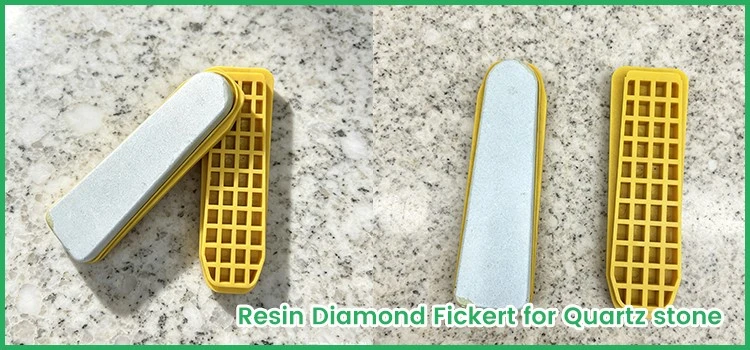
(Quartz stone specific diamond resin fickert abrasive grinding block)
II. Comparison of Abrasive Tool Selection by Processing Stage
1. Coarse Grinding and Leveling Stage (Removing saw marks and flattening the surface)
Engineered Quartz Stone
- Automated slab lines: Ceramic-bond diamond Fickert abrasives (common grits: 60#, 120#); designed to facilitate chip removal and heat dissipation, preventing resin from softening and sticking to the tool holder.
- On-site/Manual processing: Brazed diamond coarse grinding heads or 50# resin-matrix wet grinding pads; requires continuous, abundant water cooling. Dry grinding is strictly prohibited, as it can cause the slab to burn and discolor within 10 seconds
Natural Quartzite
Automated slab lines: Bronze-sintered metal-bond Fickert abrasives (common grits: 46#, 60#, 120#); characterized by strong diamond retention and high wear resistance, suitable for grinding hard minerals.
On-site/Manual processing: Metal-bond diamond grinding discs or coarse grinding pads; requires slower feed rates and uniform pressure to prevent brittle edge chipping.
2. Fine Grinding/Transition Stage (Eliminating coarse grinding scratches)
- Engineered Quartz Stone: Ceramic-bond or semi-resin-bond abrasives; progressive grits (200#, 400#, 800#) to gradually refine the surface; requires cooling to prevent resin clogging.
- Natural Quartzite: Soft metal-bond or metal-resin hybrid bond abrasives; grits 300#, 500#, 800#; designed to gradually reduce grinding force and minimize micro-chipping at the edges.
3. Fine Grinding and Polishing Stage (Achieving High Gloss and Mirror Finish)
Engineered Quartz
- Resin-bond diamond wet polishing pads/blocks (grit sizes 1000#, 2000#, and 3000#) are sufficient; a 3-step polishing system is commonly used in the industry for high efficiency.
- For the final finish, quartz-specific polishing paste and repair fluid can be applied using a wool buffing wheel to create a smooth, uniform surface that harmonizes well with the slab's resin matrix.
Natural Quartzite
- Resin-bond diamond abrasives are used, but a longer sequence of grit sizes is required-typically progressing through 1000#, 2000#, 3000#, and 5000#-often necessitating a 7-step system to completely eliminate scratches caused by hard minerals.
- Achieving a high-quality mirror finish requires an additional final buffing step using cerium oxide polishing powder; this brings out the natural crystal's luster, resulting in a more translucent and cool, crisp appearance.
III. Selection of Abrasive Types for Different Processing Scenarios
1 Automatic Large-Slab Polishing Machines (Mass Production Lines)
- Engineered Quartz: Primarily uses resin-bond Frankfurt-style blocks (or "bricks"); requires relatively low grinding head pressure and moderate rotational speeds.
- Quartzite: Uses metal-bond Frankfurt blocks for rough grinding and resin-bond blocks for fine polishing; requires high torque and stable pressure at the grinding head.
2 Shaped Edge Processing (Countertops)
- Engineered Quartz: Resin-bond shaping wheels; offer good elasticity and resist edge chipping; suitable for profiles such as backsplashes and front water-retention edges.
- Quartzite: Metal-bond shaping wheels; offer excellent profile retention and wear resistance; requires slow feed rates during processing to prevent edge chipping.
3 On-site Refurbishment / Repair
- Engineered Quartz: Diamond wet polishing pads with a sponge cushioning layer; use low speeds and frequent water application to avoid localized overheating.
- Quartzite: Standard diamond wet polishing pads are sufficient; focus on controlling the feed rate to prevent the expansion of micro-cracks.
IV. Key Principles for Selecting Abrasives to Avoid Common Pitfalls
Three Principles for Selecting Abrasives for Engineered Quartz
- Prioritize anti-clogging and heat resistance: Choose abrasives with high porosity and good self-sharpening capabilities; avoid coarse grinding with high-density, pure metal-bond tools. Continuous water cooling is mandatory.
- Do not skip grit sizes: The resin matrix is relatively soft, making it highly susceptible to deep scratches from coarse grinding. Skipping grit sizes makes it impossible for subsequent steps to fully remove these marks, resulting in lingering blemishes.
- Avoid excessive grit levels for polishing: A 3000-grit resin pad is sufficient to achieve a high-quality gloss; using excessively high grit levels can damage the surface resin layer and cause a loss of shine.
Three Principles for Selecting Abrasives for Natural Quartzite
- Use metal-bond abrasives for coarse grinding to reduce costs: Coarse grinding hard stone causes significant abrasive wear; metal-bond tools last 3–5 times longer than resin-bond tools, resulting in lower overall costs.
- Ensure gradual grit progression: Quartzite is brittle; jumping from coarse to fine grit easily causes micro-chipping and deep scratches that are difficult to repair later.
- Choose softer bonds for dark-colored stone: For dark, high-purity quartzite, select a softer bond to enhance self-sharpening and prevent the abrasive from "skidding" or failing to achieve a high polish.
If you are looking for a professional manufacturer of abrasives for quartz or quartzite, consider partnering with Cheefung Company. We have twenty years of experience in the R&D and manufacturing of stone abrasives, offering factory-direct sales and excellent value for money.