



Trade Press · Materials Science
Why Engineered Quartz Slabs Cannot Be Polished to a Mirror Finish
Set 93 per cent quartz against seven per cent resin, and the gloss ceiling is written into the slab the day the batch is formulated.
A consignment of 20 mm pure-white slabs, 3200 × 1600 mm, came back to the inspection bay of a quartz plant in Foshan. The buyer's rejection note said the surface was not bright enough. The buyer pointed at a sample of Italian marble beside it and asked for a finish you could see your face in. The plant's answer was blunt: not a refusal, a physical limitation.
That single word, brighter, runs straight into the hardest wall in the engineered-stone business. The ceiling on gloss is not set by the power of a polishing head. It is fixed the day the batch is formulated, the moment resin meets quartz grain. Visits to producers, the standard texts and published process data point to four separate ceilings stacked one behind another. Together they make the mirror finish impossible on a slab of this size.
| 92–93%quartz aggregate by mass | 7–10%polyester resin binder | 7 vs 2–3Mohs hardness, quartz vs resin |
| c. 150 °Cresin softening point | 40–60 GUtypical factory gloss | 90+ GU'mirror' threshold |
Gloss readings are 60-degree specular values. Figures vary with formulation, process conditions and test method.
IA mirror is a number, not an adjective
In the stone trade, mirror has a numeric definition. It means a 60-degree specular gloss, measured in gloss units, generally above 90 GU, over a surface whose arithmetic mean roughness (Ra) sits in the 0.01 micron band. At that scale the largest irregularities left on the surface have shrunk to a fraction of the shortest visible wavelength (0.38 to 0.78 microns). Light stops scattering and simply bounces back, which is why the eye resolves a clean reflection.
That definition reframes what polishing is. It is not a coating or a shine enhancer. It is the systematic substitution of coarse scratches by ever finer ones until the scratches fall below the scale at which they interact with visible light, followed by a chemical softening pass with a buffing compound. Nothing is added. Material is taken away.
Measured against it, the gap is plain. A polished quartz surface typically leaves the factory at 40 to 60 GU; well-controlled premium lines hold 60 to 70 GU. A properly polished natural marble runs above 90 GU. The 20 to 30 units in between are not a question of machine precision. They are a question of how two different materials are held together.
IIThe first ceiling: Mohs 7 against Mohs 3
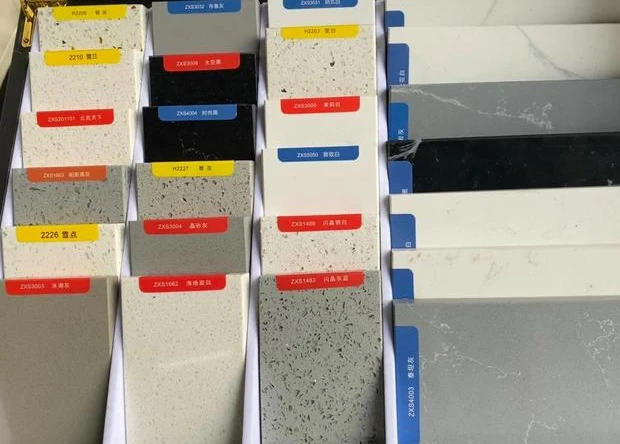
A quartz slab is not stone. It is a composite: 90 to 93 per cent quartz aggregate by mass, sometimes blended with crushed glass, mirror chips or shell, bound by 7 to 10 per cent unsaturated polyester resin (epoxy and polyurethane systems also exist) and pigment, then vacuum-vibrated, pressed, cured, calibrated and polished.
The trouble sits in the hardness gap between the two phases. Quartz measures 7 on the Mohs scale; polyester resin sits around 2 to 3. Put the same head under the same pressure on both, and the removal rates differ by a factor of several. What emerges is a microtopography: the hard grains stand proud, the soft resin recedes. The later the polishing stage, the more clearly that step is sculpted rather than smoothed away.
Light arriving at the surface meets thousands of tiny inclined planes and is scattered in every direction. This explains a familiar impression of engineered quartz: bright, but incapable of a crisp reflection. It also explains why a slab looks luminous under a shop light and hazy when a face is brought close to it.
Choosing abrasives is a dilemma in itself. Cutting quartz requires diamond or silicon carbide, and those same minerals cut resin even more aggressively, leaving hollows and smear burn. Softer media barely move the quartz and the gloss stalls halfway. Glass-bearing crystal bodies are worse: glass sits near Mohs 5.5, another full point below quartz, so a grit sequence tuned purely for quartz leaves the chips either recessed or standing proud. Points of sparkle become a string of shallow dimples. Some plants therefore grade the whole sequence to the softer phase and accept a slower line, a trade-off that never appears on a quotation.
IIIThe second ceiling: the temperature at which resin surrenders
Polishing generates heat. Friction at the head raises the surface by 10 to 15 °C per minute; a hesitation in the conveyor or a manual touch-up in one spot can push the local temperature past the limit in seconds.
Polyester resin begins to soften at roughly 150 °C (302 °F). Beyond that point it is no longer being abraded, it is being smeared: polymer chains spread under shear and heat, a grey haze blooms across the surface, and the defect the trade calls orange peel appears, a gentle undulation of softened material that no further pass will bring up.
Hence the paradox. More gloss demands more pressure, more dwell time, more head speed, and those are precisely the shortest routes to the softening point. Polishing quartz to a mirror is therefore not a question of whether but of how narrow the process window is, and narrow enough that holding it across 5.12 square metres of continuous surface is close to impossible.
That is also why polishing is a strictly wet operation in a disciplined plant. Water cools the head and, more importantly, suppresses the respirable crystalline silica dust raised by grinding. A mirror line runs more abrasive passes than a standard line, generating more heat and more dust, and the demands on cooling water, extraction and head pressure rise accordingly. Getting brighter is physically more expensive.
"The brighter you want it, the harder you press. The harder you press, the closer you get to the point where the resin gives up."
The constraint on a mirror line is thermal before it is mechanical.
IVThe third ceiling: voids and refractive index, magnified by gloss
Vacuum vibro-compression is where the slab is formed. A mix at roughly 92 per cent solids is held under vacuum approaching minus 0.095 MPa and around 25 bar for two to three minutes to evacuate trapped air. Some air always remains between particles, closing into voids a few tenths of a millimetre across.
On a matte surface those voids are effectively invisible. At 90 GU every one of them becomes a dark speck or a bright point: the gloss gathers the light and points at the defect. This is why the trade says that a mirror finish is decided at the press, not at the polishing line. A marginally weaker vacuum or a shortened dwell is harmless noise on a standard finish and grounds for rejecting an entire batch on a mirror.
The obvious remedy is more resin, filling the interstices. But more resin means lower hardness, lower abrasion resistance and a surface that marks more easily, trading one defect for another. The formulation is caught in the middle.
There is a subtler layer in optics. Quartz has a refractive index near 1.54, polyester resin around 1.50 to 1.57 depending on formulation, and pigments and fillers each carry their own. Even a geometrically perfect surface still scatters light at the thousands of grain-resin interfaces immediately beneath it. Polished marble reads as deep because it is a single mineral from skin to core and light travels into it. Light on engineered quartz largely stops at the resin skin and is thrown back: bright but not translucent, white but flat. No abrasive alters that.
VThe fourth ceiling: flatness across 5.12 square metres
Size is its own problem. A 3200 × 1600 × 20 mm slab covers 5.12 square metres at an aspect ratio of about 1:160, closer to a plate than a block. Under head pressure it deflects elastically and springs back as the load passes. The polisher reproduces that deflection faithfully: it refines a surface, it cannot correct geometry.
The standard allows rough slabs a flatness deviation of up to 1.5 mm per metre and a thickness tolerance of ±0.5 mm. Calibration must be completed on a cool slab before polishing begins. Carry a wave into the polishing line and it emerges as a reflection that will not hold still, straight lines drawn into soft arcs, the effect the trade calls water wave.
The larger the format, the greater the amplification. A 600 × 600 mm sample can be made to look immaculate; transfer the identical process to a 3200 × 1600 mm slab and you get gloss variation between centre and edge, water wave and patchy orange peel at once. Yield is eaten by area: a mirror finish drives tolerance to zero while a large format maximises the number of places a defect can occur.
VIThe arithmetic: a mirror finish does not pay
Lifting a slab from 50 GU to 90 GU carries costs that can be itemised.
▪ Abrasive sequence: from 50 grit through 100, 200, 400, 800, 1500 and 3000, then a buffing compound. Nine heads, each removing 8 to 15 microns, about 0.1 mm in total.
▪ Time and energy: a doubled sequence doubles power, water and abrasive consumption and slows the line.
▪ Yield: pinholes, resin burn and wave all surface under a mirror; rework amounts to re-polishing from the start.
▪ Service life: the skin is still resin, Shore D hardness of 60 or above, pencil hardness around H. Routine wiping leaves micro-scratches, and the brighter the finish, the more visible each one becomes.
Nor does the standard ask for it. The Foshan group standard for resinous agglomerated quartz slabs, still in draft, requires only a minimum of 40 GU on polished products; in project handover, 45 to 60 GU is routinely accepted. Put plainly, the market is buying 40 to 60 and paying for 90, and nobody is invoicing the extra 30 units.
One further point needs stating. Much of what is sold as a mirror upgrade is wax and optical brightener. Third-party testing bodies are explicit about it: a coating lifts the reading for a few weeks, then volatilises or wears through and the slab reverts. Some budget material measures brilliantly waxed and looks ordinary within months. Gloss measures the ability of a surface to reflect light. It does not measure hardness, abrasion resistance or quality. Chasing the number is an easy way to buy a false shine.
| Surface material | Surface architecture | Typical 60° gloss | Achievable Ra (µm) | Mirror capable |
|---|---|---|---|---|
| Natural marble, polished | Single calcite phase, homogeneous | 90–100 GU | 0.005–0.02 | Yes |
| Granite, polished | Interlocking crystals, hard-phase dominated | 85–95 GU | 0.02–0.05 | Close |
| Sintered stone, polished | Glass-ceramic, no resin phase | 85–95 GU | 0.01–0.03 | Yes |
| Engineered quartz, polished | Quartz aggregate plus polyester resin | 40–70 GU | 0.1–0.3 | Not reliably |
| Engineered quartz, matte | Dual-phase body, textured surface | 5–20 GU | 0.8–2.0 | Not applicable |
Sources: GB/T 35157-2017, Resinous Synthetic Stone Slabs; Foshan group standard draft for resinous agglomerated quartz slabs; published manufacturer process data and third-party laboratory technical notes. Ranges are indicative and should be replaced by test data for a specific product.
VIIThe industry is changing the subject
Step back and the argument over gloss turns out to be one the industry is already walking around.
China is the world's largest producer of engineered quartz. Capacity at the end of 2025 stood at about 185 million square metres a year against output of 142 million, a utilisation rate of 76.8 per cent and oversupply above 40 per cent. Production is concentrated in Guangdong (31.4 per cent, around Foshan and Yunfu), Jiangsu (14.1 per cent) and Fujian (10.3 per cent). In the premium bracket above US$200 per square metre, however, Italian brands hold 54.2 per cent of the global market against 9.6 per cent for Chinese producers as a whole.
The gap is not about brightness. What decides a high-end project is whether shade matches slab to slab, whether pinholes have been eliminated, whether the veining is designed rather than accidental, and whether crystalline silica can be taken out of the mix altogether. Since the European Union and Australia tightened limits on respirable crystalline silica in engineered stone, silica-free has moved from selling point to entry requirement.
Taste is moving too. Matte, silk-touch, leather-grain and micro-cement surfaces have become the new premium signals. When bright no longer means expensive, delivering 60 to 70 GU with no pinholes, no shade drift, no wave is worth more commercially than producing a single 90 GU sample. The line heard across the trade says it best: what clients complain about was never not bright enough, it is this slab not matching that one.
VIIIVerdict: it can be polished very bright, but not to a mirror
Return to the rejected consignment. The fault lies neither with the polishing line nor with the operators. Four ceilings close in, one after another.
The hardness gap between the phases defines the microtopography. The 150 °C softening point of the resin defines how wide the process window can be. Voids and refractive-index mismatch define how far light can travel. The 5.12 square metre format defines the ceiling on yield. Stacked together, they hold the practical limit at 60 to 70 GU.
Engineered quartz can be polished to a very high brightness. It cannot be polished to a mirror, because a mirror demands the perfection of a single material, and this product is born as a compromise between two. That same compromise is what makes it hard-wearing, stain-resistant, shade-consistent and capable of mass production. It is also what leaves it short of a true reflection.
Understanding that is more useful than asking for one more point of gloss. Buyers should inspect flatness, shade and pinholes instead of holding a marble sample up to the light. Producers will do better stabilising vacuum, cure profile and calibration precision than gambling on the last head. And the industry will only address its real weaknesses, consistency and design, once mirror stops being the only respectable finish.
Sources
- GB/T 35157-2017, Resinous Synthetic Stone Slabs, China national standard.
- Group standard for resinous agglomerated quartz stone slabs (draft for comment), Foshan.
- Apex Quartz Stone, technical note on mirror-finish manufacture: head sequence, vacuum and cure.
- Manufacturer care guidance and restoration notes on resin softening at c. 150 °C (302 °F).
- Third-party laboratory papers on gloss measurement and coating-induced false gloss.
- Market report on the quartz surface sector: 2025 capacity, output and regional spread.
- Yunfu Customs and Yunfu Daily: stone product exports, January to August 2025.
Editor's note: this article is an industry analysis based on published standards, manufacturer documentation and trade data. Performance figures are indicative ranges and are not a specification for any product.
Disclaimer
This article is published for general information and industry discussion only. It is not technical, engineering, procurement, contractual or legal advice, and is no substitute for professional assessment of any particular product, process or project. Formulations, cure profiles, polishing sequences and measured performance differ between manufacturers and between batches. All figures are indicative industry ranges taken from published sources at the time of writing; gloss, roughness and other physical values should be verified by test to the applicable standard at an accredited laboratory. The specifications, warranties and documentation issued by the relevant supplier prevail in all cases. Reference to any brand, process or standard is for identification only and implies no endorsement. The publisher and contributors accept no liability for loss or damage arising from reliance on this article. All trademarks remain the property of their respective owners.
Advertisement
CHEEFUNG- Fickert & Frankfurt Abrasive for Slabs
Built for the microns between bright and burned.
Cheefung designs and manufactures abrasive tools and polishing consumables for natural stone and engineered stone, covering the full sequence from coarse grinding to final buffing. Metal Bond & Resin Bond Diamond Fickert Abrasive, Metal & Resin Diamond Frankurt Abrasives, flexible polishing pads and resin-bonded discs are developed around the material they will cut: the same head that flattens a quartz grain can soften the resin holding it. We know where that line is.
ApplicationsQuartz slabs, marble, granite, sintered stone, solid surface |
Product rangeMetal-bond diamonds, resin-bond discs, wet polishing pads, buffing compounds |
Custom workGrit sequence, bond hardness and backing tailored to line speed and slab format |
Cheefung · Abrasives and tools for natural and engineered stone · OEM / ODM enquiries welcome