

1 Basic Definitions
Diamond grinding discs (also known as Resin Polishing Disc, Diamond Polishing Disc, Buff Polishing Disc) are circular diamond abrasive tools designed for use on manual polishing machines or automatic line polishing machines.These abrasives are applicable for rough-polishing and smoothening to the surface of granite or marble stone slabs.
Structural Features
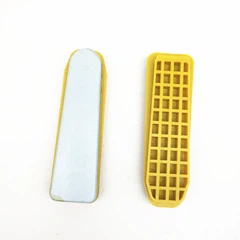
Backing plate: Made of plastic,Rubber, bakelite
Diamond working layer: Composed of metal or resin bonds embedded with synthetic diamond particles; this is the core component for grinding and polishing.
2 Main Material Categories
Metal-Bond vs. Resin-Bond Grinding Discs
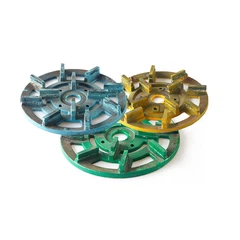
1. Metal-Bond Diamond Grinding Discs (For Coarse Grinding)
Matrix: High-temperature sintered iron-copper alloy powder; offers strong diamond retention.
Grit Range: 30#, 50#, 80#, 120#; used exclusively for coarse leveling, adhesive removal, edge/lip leveling, and stripping old surface layers.
Features: High cutting power, excellent wear resistance and durability, and no grit shedding; capable of handling uneven surfaces, thick grime, and damaged areas.
Limitations: Produces coarse scratch patterns; cannot achieve a polished finish directly and requires subsequent fine grinding; the material is relatively hard, so heavy pressure can easily scratch soft marble.
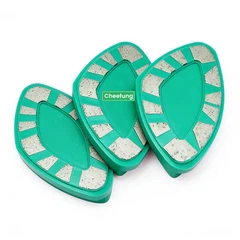
2. Resin-bond diamond grinding discs (primary tools for intermediate grinding and polishing)
These have the highest market volume and come in a complete range of grit sizes covering coarse, medium, fine, and polishing stages:
Grit sequence: 200#/400#/800#/1500#/3000#/5000#/
Features: Excellent self-sharpening properties and gentle grinding action; produces progressively finer scratch patterns, with high-grit discs capable of achieving a mirror-like finish; good toughness, minimizing edge chipping on corners and thin slabs;
Drawbacks: Lower wear resistance compared to metal-bond discs (resulting in faster wear during coarse grinding); not resistant to dry grinding-wet grinding with water is mandatory throughout the process.
There is also a category of soft, elastic resin wet-polishing pads featuring a softer matrix; specifically designed for softer stones-such as marble, beige limestone, and exotic "luxury" stones-they prevent scratching and preserve the stone's base color.
3. Buff Polishing Disc
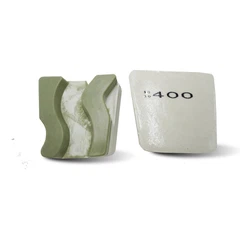
Buff disc is pressed buff abrasives with exclusive bond which is used to make the final polishing or buffing on soft to hard granite slab surface in automatic line polishing machine or manual polishing machines, mostly for polishing granite strips or tiles up to 1.2m width.By using the buff the glossiness can easily reach 85-110 degree.


(Metal Bond, Resin Bond and Buff Diamond Grinding Discs)
3 Types of Compatible Polishing Machines
Manual single head polishing machine
Automatic single head bridge polishing machine
Automatic multi head polishing machine

4 Standard Grinding Processon
Scenario 1: Granite flooring/slabs (hard stone)
Metal disc 50# (leveling) → Resin 200# → 400# → 800# → 3000# (mirror finish)
Scenario 2: Turkish Beige, marble, and luxury stone (soft stone)
Lightweight metal 120# (light leveling) → Soft resin 400# → 800# → 3000# → 5000# (high-gloss finish)
Traditional methods previously concluded with manual polishing using magnesite pads, but these have largely been replaced by high-grit resin discs.
5 Comparison: Grinding Disc vs Frankfurt-Fickert Abrasive
Form: Grinding discs = small circular pads; Frankfurt bricks = elongated horseshoe-shaped blocks
Equipment: Grinding discs → single-head walk-behind or small machines; Frankfurt bricks → fully automated multi-head continuous production lines
Operation: Grinding discs = manual handheld grinding; Frankfurt bricks = automated machine-driven processing
Application: Grinding discs = repair, restoration, irregular shapes, small-batch sampling; Frankfurt bricks = mass production of full slabs
Wear characteristics: Grinding discs = uneven manual pressure, wear rate depends on operator technique; Frankfurt bricks = uniform pressure, consistent service life
6 Key Advantages and Disadvantages
- Advantages
Highly versatile; capable of grinding irregular shapes, corners, columns, curved surfaces, and localized damage-tasks that automated production line equipment cannot handle.
Rapid setup and changeover; grit levels can be switched in minutes using a simple hook-and-loop (Velcro) system.
Compatible with a full range of materials, including natural stone, concrete, engineered stone, and quartz.
An essential consumable for small-batch prototyping, post-installation repairs, and renovation projects.
- Disadvantages
Manual operation; processing efficiency for large slabs is far lower than that of automated lines using abrasive blocks.
Inconsistent manual pressure can easily result in uneven grinding marks (varying depths) or wavy surface patterns.
Production costs and labor hours for large, flat surfaces are significantly higher compared to automated processing with long abrasive blocks.