

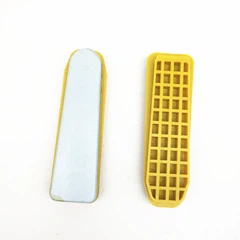
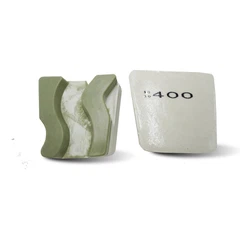
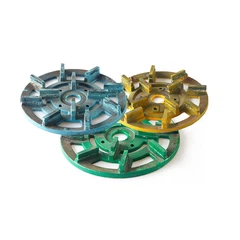
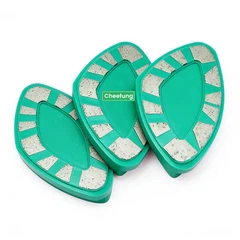
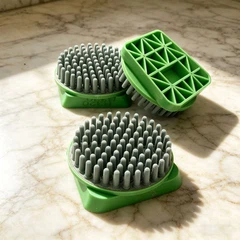
Key defects associated with processing "luxury stones" using metal-bond Diamond Frankfurt Abrasive
Luxury stones generally feature a soft carbonate marble matrix (Mohs hardness 3–4) interspersed with mica, feldspar, quartz, mica flakes, colorful mineral veins, and natural micro-fissures. They possess uneven hardness, brittle layered crystals, and a precious base color that must not be damaged. Metal horseshoe segments-characterized by hard matrices, aggressive cutting power, and high rigidity-are designed for the rough grinding of granite; using them on luxury stones causes irreversible defects in the finished product. These defects fall into six main categories, detailed below:
Ⅰ. High risk of leaving deep, coarse, permanent scratches that cannot be removed during later stages
- The sharp, protruding diamond particles in the metal matrix cut deeply; coarse segments (e.g., 36# or 60#) gouge out deep, wide grooves. Because the soft matrix of luxury stones has poor structural integrity, these scratches are far deeper than those found on standard beige marble. Subsequent resin segments (400#–5000#) cannot fully fill or level these gouges, leaving the slab surface covered in faint hairline marks and alternating light/dark streaks-imperfections that become glaringly obvious when the stone is backlit.
- Metal filings and coarse diamond fragments dislodged during grinding mix with the water and are forced into the stone's capillary pores, creating gray metallic indentations-permanent marks that cannot be washed away.
- Luxury stones contain an interlaced mix of soft and hard mineral veins: the soft calcium-magnesium matrix is rapidly ground down, while hard crystals (quartz, mica) resist grinding and remain raised. The abrasive segments repeatedly scrape against the edges of these protruding crystals, creating clusters of scratches.

II. Differential cutting of soft and hard mineral veins; surface waviness and localized collapse
the most critical defect leading to scrapping
Metal grinding blocks are rigid and lack cushioning, reacting aggressively to material hardness variations:
- The soft base-color matrix of the luxury stone is rapidly cut away, creating depressions, while the hard internal quartz, shimmering mica, and metallic mineral inclusions resist grinding; this results in wavy patterns, pitting, and an uneven surface, rendering the slab unusable due to poor flatness.
- Mica layers possess a flaky, laminated structure; heavy pressure from metal blocks can dislodge mica flakes, causing irreparable surface pits and voids. In high-end translucent luxury stones, such pitting completely destroys the material's characteristic translucency.
- An "orange peel" surface texture emerges; no amount of subsequent fine grinding can eliminate the undulations and refraction issues, resulting in a mottled, uneven gloss.
III. High heat generation; scorching of the base color, discoloration of mineral veins, and loss of crystal luster
- Metal-bonded tools conduct heat rapidly but encounter high cutting resistance, generating intense heat during high-speed processing. The colored mineral veins, mica, and labradorite in luxury stones are highly sensitive to heat; scorching causes veins to turn white or gray and lose their shimmer, instantly destroying effects like "starlight" or iridescence (seen in varieties such as Blue Jade/Blue Emerald or Snow Mountain Blue).
- High temperatures soften the calcium carbonate on the stone's surface and disrupt its microscopic structure, causing the base color to appear whitish or hazy and stripping away its natural, warm luster-thereby devaluing the premium stone due to color degradation.
- Even a slight insufficiency in water supply can cause instant scorching and localized blackening (carbonization), resulting in the total loss of the slab.
Ⅳ. High impact force causes edge chipping, corner breakage, and the expansion of natural micro-cracks.
- The combined weight of metal-bond abrasive blocks and high grinding-head pressure creates intense vibration during rigid grinding. Luxury stones are often brittle and riddled with natural fine fissures; the combination of vibration and aggressive cutting elongates and widens these inherent micro-cracks, making the stone highly susceptible to breakage during subsequent transport and installation.
- Stress concentrates on the edges and corners of large slabs and complex profiles; aggressive metal grinding easily causes edge chipping or corner breakage. Given the high unit price of luxury stone, such damage results in significant financial loss.
- For composite/thickened luxury stones or ultra-thin translucent varieties, the heavy pressure from metal blocks can cause invisible internal structural damage, leading to delamination or cracking later on.
Ⅴ. Metal dust infiltrates pores, causing rust-like yellow stains and mineral contamination.
Grinding with metal blocks continuously generates copper and iron dust. Luxury stones often have porous structures that allow this metal dust to penetrate the interior:
- Exposure to workshop humidity causes oxidation, resulting in yellowish-brown or green rust spots on the surface. These stains penetrate deeply and cannot be cleaned or removed, leaving permanent blemishes.
- On light-colored or white-based luxury stones (such as Statuario or Snow White), rust spots are visually jarring, rendering the product commercially worthless.
- Metal dust accumulates deep within voids and fissures; applying protective sealants traps these contaminants inside the stone, leading to gradual yellowing over time.
Ⅵ. Extremely low process tolerance; minor machine adjustment errors can result in the scrapping of entire batches.
- Excessive grinding pressure or slow feed rates immediately cause deep scratches or surface depressions. While softer luxury stones require low-pressure processing, metal blocks tend to become dull and slip under low pressure, creating a processing dilemma.
- Excessive jumps in grit size (e.g., skipping directly from #36 to #120) make it impossible to hide coarse scratches. Unlike ordinary marble, where minor adjustments can compensate for issues, luxury stone offers virtually no room for repair.
- Even slight dullness or unevenness in the abrasive blocks (variations in height or thickness) immediately causes uneven gloss levels or localized depressions, resulting in prohibitively high rework costs for batch production.
VII. Additional Drawbacks of Associated Processing Methods
- Excessive stock removal during the initial metal grinding stage can grind away the most beautiful surface mineral patterns and crystalline "starlight" effects of luxury stones, reducing a premium slab to a plain, uniform background and wasting high-end raw blocks.
- Following the metal grinding stage, an additional 2–3 steps of fine resin grinding are required to mitigate surface damage; this doubles the consumption of abrasives and labor hours, leading to a significant rise in production costs.
Supplementary Note: Industry-Standard Mitigation Strategies
- The use of coarse-grit (36#/46#) metal abrasive blocks is prohibited for luxury stones, eliminating the aggressive initial cutting/grinding stage;
- Only low-copper, soft-matrix metal blocks (120#) may be used, employing minimal pressure and high-speed slab movement to merely lightly smooth out saw marks;
- Mainstream, proven process: Transition using low-cutting-force 120# soft metal blocks → progressive grinding with a full set of ultra-soft, flexible resin abrasive blocks; this completely avoids prolonged processing with aggressive, hard-matrix metal abrasives.

Quick Comparison: Metal-Bond vs. Soft Resin Frankfurt Abrasive for Luxury Stone Processing
| Comparison Aspect | Metal-Bond Frankfurt Abrasive | Soft Resin Frankfurt Abrasive (Specialized for Luxury Stone) |
| Cutting Characteristics | Rigid, aggressive cutting; deep penetration | gentle grinding; minimal material removal |
| Surface Flatness | Risk of unevenness (dips at veins, waviness, or pitting) |
Uniformly flat surface; no uneven spots or height variations |
| Scratch Risk | Deep, coarse, permanent scratches; difficult to buff out |
Fine scratches easily removed by subsequent high-grit steps |
| Heat/Burn Risk | High heat can burn veins and dull crystals | Low frictional heat; preserves color and vein details |
| Cracking/Chipping | Vibration/impact can cause cracks or corner chipping |
Gentle cushioning protects delicate veins and edges |
| Metal Contamination | Iron/copper dust can seep into pores, causing rust stains | Iron/copper dust can seep into pores, causing rust stains |
| Process Tolerance | Very low; machine setup errors can ruin the slab |
High tolerance; minor pressure fluctuations do not cause defects |