

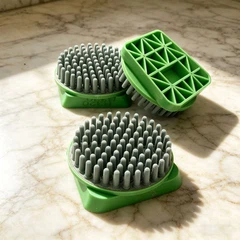
What are the advantages and disadvantages of diamond-filled nylon abrasive brushes?
I. Key Advantages
1. Superior wear resistance and lifespan compared to standard silicon carbide nylon Abrasive Brushes
- The brush filaments are impregnated with synthetic diamond micro-powder-a material far harder than silicon carbide. Offering approximately double the service life of silicon carbide brushes for the same processing area, they are ideal for 24-hour mass production lines processing high-hardness stones like granite and engineered quartz, thereby reducing downtime for brush replacement and lowering labor and consumable costs.
2. Stable cutting force; no slipping or dulling when processing hard stone
- Designed for high-quartz, hard slabs such as granite, Black Galaxy, Indian Red, and engineered quartz, these brushes deliver robust cutting power. Unlike silicon carbide brushes, which can quickly flatten and lose their abrasive effect after processing just a few dozen square meters, these maintain consistent texture throughout the process. This ensures uniform gloss and antique-style finishes across entire batches of large slabs, simplifying color consistency control for export-grade projects.
3. Controllable finish quality with a full range of grit sizes for versatile application
- Covering the entire spectrum-from 24# (coarse antique/water-washed finish) and 60–120# (standard exterior wall matte finish) to 320# (soft matte) and 800–1200# (leather/satin finish)-a single set of diamond brushes handles all granite matte and antique finishing needs, eliminating the need to frequently switch between steel wire and silicon carbide brushes.
4. Uniform filament wear prevents surface streaks and blotches
- With diamond particles evenly dispersed throughout the nylon matrix, wear occurs synchronously, preventing localized flat spots. When used with adequate water supply, the brushes minimize the risk of uneven polishing or "shadowing" (inconsistent surface appearance), resulting in a higher yield of qualified finished products.
5. Resistant to water and alkaline workshop circulating water; durable against corrosion and filament breakage
- Constructed from high-toughness, wear-resistant PA612 nylon, the brushes offer excellent resilience and fatigue resistance against reciprocating motion. They resist brittle fracture and filament loss even in the mildly alkaline environments typical of stone workshops (where circulating water contains stone dust), offering far greater durability than standard, low-quality silicon carbide nylon brushes.
6. No risk of metal contamination (compared to steel wire abrasive brushes)
- As it contains no stainless steel wire, it does not cause yellow rust stains when processing light-colored granite or stone with light-colored backgrounds. It eliminates the need for additional cleaning or rust removal, making it suitable for light-colored exterior walls and indoor flooring.

II. Significant Drawbacks
1. Higher unit purchase price and substantial initial investment
- Due to the high cost of diamond raw materials, the selling price of diamond nylon brushes (whether individual units or full sets) is far higher than that of silicon carbide brushes;
- cost advantages are not apparent in small-batch orders or short-term, sporadic processing scenarios.
2. Unsuitable for processing soft marble or "luxury stones"
- Diamond particles are sharp; materials such as soft beige marble, Statuario (Fish-Belly White), and various luxury stones have soft textures and brittle mineral veins, making them highly susceptible to fine, permanent scratches. Usage is largely restricted to granite and engineered quartz, limiting versatility.
3. Accelerated wear rates for high-grit (fine) brushes (above 600#)
- For fine-grit diamond brushes (400#, 800#, 1200#), the diamond micro-powder particles are small and the nylon content is high; consequently, they wear out faster when creating fine leather or satin finishes, resulting in shorter replacement cycles compared to coarse-grit brushes.
4. Prone to creating glossy "mirror-like" spots under heavy pressure
- If the grinding machine pressure is set too high, the flexible nylon bristles become compressed and the diamond particles press too firmly against the slab surface, creating glossy patches that ruin the uniform matte/antique finish; this places higher demands on the operator regarding machine parameter settings.
5. More difficult to clean after clogging compared to silicon carbide abrasive brushes
- Grinding granite produces large amounts of hard silica dust that easily embeds in the gaps between the diamond brush bristles; while silicon carbide brushes can be cleaned with a simple water rinse, severely clogged diamond brushes require prolonged washing with a high-pressure water gun, making the cleaning process more time-consuming.

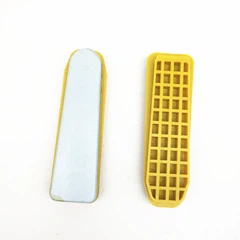
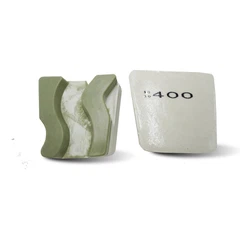
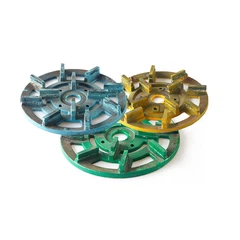
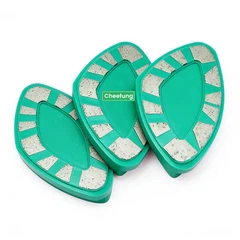
(Different types of diamond abrasive brushes bristles)
III. Summary of Suitable and Unsuitable Scenarios
✅ Suitable for: Various large granite slabs, engineered quartz, and engineered stone (agglomerated stone) antique/matte finish production lines; long-term, high-volume processing of exterior wall panels for export.
❌ Unsuitable for: Marble, beige stones, luxury stones, and precision finishing of thin or soft stone slabs.
Cheefung supplies professional Diamond Stone Abrasive Brushes and is an industrial factory specializing in the production of grinding and polishing tools for stone surfaces. Not only do we provide professional and cost-effective stone Grinding & Polishing tools, but we also offer customers various stone grinding and polishing solutions.