

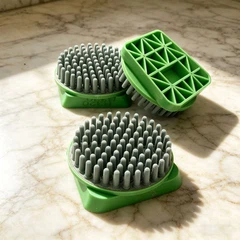
How do you select the diamond grit size for diamond-impregnated nylon stone abrasive brushes?
Diamond-Impregnated Nylon Stone Abrasive Brush: Comprehensive Grit Selection Guide
Key Principles
- Lower grit numbers indicate coarser diamond particles, resulting in stronger cutting action, deeper surface texture, and lower gloss.
- Higher grit numbers indicate finer diamond powder, resulting in gentler grinding, a smoother surface finish, and higher gloss.
Suitable only for granite, engineered quartz, and engineered stone; strictly prohibited for use on marble or luxury stones.
I. Full Grit Range: Classification, Texture, Gloss, and Applicable Processes
Compatible with Factory Assembly Lines
1) Coarse Antique/Washed Finish: 24# / 36# / 46#
- Extremely coarse grit with maximum cutting power; creates deep, textured "washed" surfaces and a rugged, vintage look.
- Gloss: 5°–15°; pronounced relief/texture; excellent slip resistance.
- Applications: Refinishing flamed or bush-hammered slabs, thick exterior cladding, landscape stone, and river-washed antique-style slabs.
- Process Sequence: Metal brush (rough grinding) → 400# matte resin (base layer) → 46# diamond brush (shaping).
- Note: Coarse brushing only establishes the initial texture; it cannot serve as the final step and must be followed by fine brushing to even out the texture.
2) Standard Exterior Matte Antique Finish (Best-seller for Projects): 60# / 80# / 120#
The most common specifications for granite used in dry-hanging exterior cladding for export markets.
- Moderate cutting action; creates a uniform, fine matte texture without deep pits.
- Gloss: 15°–28°; resistant to water stains in rainy weather; minimal color variation.
- Applications: Building facades, public flooring in shopping malls, and mass-produced, cost-effective antique-style slabs.
- Standard Process: Metal brush (rough grinding) → 400# matte resin → 60# coarse brush (shaping) → 120# fine brush (uniforming the surface texture).
3) Fine Soft-Matte Finish: 180# / 240# / 320#
Softens coarse grit marks; creates a smooth, gentle surface with virtually no visible deep relief.
- Gloss: 28°–35°; refined matte finish; top choice for commercial interior projects.
- Applications: Villa interior flooring, stair treads, and light-colored granite interior walls.
- Often used as an intermediate step for leather finishes, bridging the gap between coarse brushing and high-grit fine polishing brushes.
4) Leather/Satin/Silky Soft Finish (High-End Finish): 400# / 600# / 800# / 1000# / 1200#
Ultra-fine diamond powder allows for gentle, light polishing, creating a warm, silky texture reminiscent of genuine leather.
- Gloss level: 35°–42° (soft sheen); glare-free, fingerprint-resistant, and hides water spots.
- Applications: High-end granite kitchen countertops, bar counters, feature walls, and luxury hotel interiors.
- Process logic: Initial base processing with 60#/120# grits, followed by a final polish with 800#/1000# grits to eliminate mechanical sanding marks.
II. Three Mainstream Finished Product Grit Combination Schemes (Granite Production Line Practice)
Scheme 1: Exterior wall "washed-look" rustic finish (for export/dry-hanging systems)
- 46# diamond brush for shaping → 120# diamond brush for texture uniformity.
- Final gloss: 10°–20°; rugged, slip-resistant, designed for outdoor use.
Scheme 2: Standard matte rustic finish (for large-scale domestic projects)
- 60# base processing → 120# refining.
- Final gloss: 20°–28°; cost-effective and fastest production turnaround.
- Scheme 3: High-end soft-matte leather finish (for villas and luxury countertops)
- 120# for texture creation → 320# for transition → 800#/1000# for fine, soft finishing.
- Final gloss: 30°–40°; refined, silky sheen; commands a higher market premium.

(Diamond Abrasive brush on stone polishing production line)
III. Five Key Criteria for Grit Selection
1. Desired texture depth
- Rugged/vintage or "washed" (textured) look: Choose coarse grits (24#–46#).
- Standard uniform matte for exterior walls: 60#, 80#, 120#.
- Smooth, refined, soft-matte leather look: Fine grits (320# and above).
2. Stone hardness
- Ultra-hard stones (e.g., Black Galaxy, Indian Black, engineered quartz): Lower grit numbers (60#/80#) can be used for easier cutting.
- Medium-hardness granite with light patterns (e.g., Golden Hemp/Gold Granite, Grey Hemp/Grey Granite): Priority selection. 120# and 320#; avoid coarse grit scratching light-colored base tones.
3. Consider the application scenario: indoor vs. outdoor
- Outdoor facades and courtyards: 60#–120#; textured/microporous finish for slip resistance and weather durability.
- Indoor countertops and interior walls: 320#–1000#; smooth and soft to the touch, not rough or abrasive.
4. Production line capacity and cost considerations
- High-volume, budget-friendly projects: Use only two steps (60# + 120#); low consumable waste and less frequent brush replacement.
- High-end custom orders: Add fine brushing steps (400#/800#); higher value-added product, though fine-grit brushes wear out faster.
5. Matching with preliminary matte resin processing
- 400# matte resin base coat → pair with 60#–320# antique brushes.
- 600# soft-sheen resin base coat → pair directly with 800# or 1000# fine leather-finish brushes.
Ⅳ. Practical tips to avoid pitfalls
1 Do not skip large grit intervals
- Do not jump directly from 46# to 800#; coarse grit marks cannot be fully eliminated, resulting in a mottled surface with uneven light and dark patches. Progression must be gradual, moving from coarse to fine.
2 Avoid excessive pressure with high-grit fine brushes (above 600#)
- Heavy pressure compresses the nylon bristles, causing the diamond abrasive to press hard against the slab and create localized shiny streaks, ruining the uniform matte leather effect.
3 Avoid using ultra-coarse brushes (24#/36#) on light-colored granite
- Coarse diamond particles easily leave fine, deep scratches that are highly visible on light-colored surfaces; start with a minimum of 60#.
4 Uniform grit principle
- All brushes on the same grinding head must have the exact same grit rating; mixing new/old or coarse/fine brushes will result in significant color inconsistency (shading differences) across the slab.
V. Quick Selection Guide
| Finished Appearance | Recommended Final | Grit 60° Gloss | Level Suitable Applications |
| Deep-brushed Antique | #46 | 5–15° | Exterior wall cladding (thick slabs), landscape paving |
| Standard Architectural Matte | #120 | 15–28° | High-rise dry-hanging facades, shopping mall flooring |
| Fine Soft-Matte | #320 | 28–35° | Villa interior flooring, staircases |
| Leather-like Satin | #800-#1000 | 35–42° | High-end countertops, premium interior wall finishes |