

Currently, common countertop materials used in furniture include sintered stone, crystallized glass, laminated stone, and natural marble (luxury stone). How should we go about making a selection when shopping? And how can we distinguish between them?
About Sintered Stone
Sintered stone is a new type of extra-large-format porcelain material produced from natural raw materials through a specialized process. It is formed using presses exerting over 10,000 tons of pressure (exceeding 15,000 tons), combined with advanced manufacturing technologies, and fired at temperatures exceeding 1200°C. This results in a material capable of withstanding various processing procedures such as cutting, drilling, and polishing.
In the current market for sintered stone dining tables, common thicknesses typically include 3mm, 6mm, and 12mm. A widespread misconception exists-promoted by 90% of market vendors-that "the thicker the sintered stone, the better."
First, we must clarify one point: whether the sintered stone is 3mm, 6mm, or 12mm thick, it undergoes compression by heavy machinery exerting tens of thousands of tons of force during the manufacturing process. After this heavy-duty compression, it is subjected to high-temperature firing exceeding 1200°C. Consequently, the internal structure of all these sintered stones is identical; they exhibit extremely dense physical properties and possess superior stain resistance.
First, we must clarify one point: whether the sintered stone is 3mm, 6mm, or 12mm thick, it undergoes compression by heavy machinery exerting tens of thousands of tons of force during the manufacturing process. After this heavy-duty compression, it is subjected to high-temperature firing exceeding 1200°C. Consequently, the internal structure of all these sintered stones is identical; they exhibit extremely dense physical properties and possess superior stain resistance.
In the current market for sintered stone furniture, the 12mm category is particularly chaotic and flooded with "ceramic tiles" masquerading as sintered stone. Some vendors selling these "fake sintered stones" exploit the consumer's ingrained belief that "thicker is better." They heavily promote their 12mm-or even thicker-products, branding them with impressive-sounding labels such as "Imported Sintered Stone," "SSS-Grade Sintered Stone," or other premium-sounding titles. By offering these products at low prices, they create a false illusion of high value for money. In reality, there is a high probability that these are merely ordinary ceramic tiles. This explains why you might purchase a dining table that appears to have top-tier specifications, only to discover shortly after use that you have fallen victim to a defective product. Thin-slab sintered stone-often referred to as "true" sintered stone-demands more sophisticated manufacturing techniques. Visually, these thinner materials appear lighter and more elegant, making them a preferred choice for high-end, minimalist dining tables; consequently, they typically command a higher price point than their thicker counterparts.
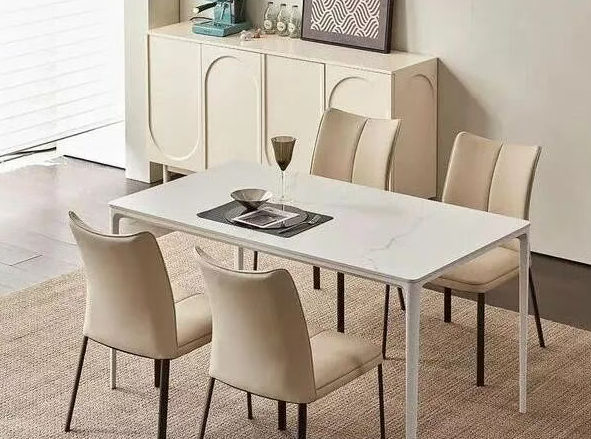
(Sintered Stone Tea Table)
Regarding the Base Plate:
Does a sintered stone dining table require a base plate? Does the presence of a base plate necessarily indicate superior quality?
The answer is: When purchasing a mid-to-high-end dining table, you should disregard the notion that a base plate is essential.
A base plate primarily serves two functions: enhancing the table's overall stability and acting as the structural link between the table legs and the tabletop. Provided these two functional requirements are met, the actual necessity of a base plate is ultimately determined by the specific structural design of the table.
Tables featuring "recessed" legs-where the legs are set inward from the edges-experience a concentration of structural load, typically focused toward the center of the tabletop. To ensure the overall structure remains stable and durable, while also achieving a more aesthetically pleasing connection between the legs and the top, the addition of a base plate becomes necessary.
For tables utilizing 3mm or 6mm sintered stone slabs, a layer of tempered glass is typically laminated underneath. In a "3+8" composite tabletop (3mm sintered stone bonded to 8mm glass), the underlying glass layer recedes into the shadows once the product is finished. This design maintains structural stability while creating the visual illusion of a single, slender layer of sintered stone, resulting in a look that is distinctly lighter and more refined.
Conversely, tables featuring a frame that aligns flush with the edges of the tabletop distribute structural loads evenly across the perimeter. Such designs do not require a base plate to achieve excellent stability, thereby allowing for a lighter, more aesthetically pleasing profile. For longer tables, the addition of a single central crossbeam is sufficient to ensure structural rigidity, while simultaneously lending the piece a lighter, more contemporary aesthetic.
Microcrystalline Stone
Microcrystalline Stone: This material utilizes natural "Guangxi White" marble as its base substrate, with a surface that displays highly realistic marble textures created through 3D or 5D laser printing technology.
Since it relies on laser printing technology, microcrystalline stone is available in a wide variety of stone textures. As laser printing technology continues to advance, the degree of realism is constantly increasing; so, how can we distinguish it from the real thing?
1. Examine the Texture:
After all, the patterns are artificially printed, so they lack the natural warmth and translucence characteristic of genuine stone textures. However, in some lighter-colored varieties, one may still observe visible stone crystals; this is because the "Guangxi White" natural marble used as the base material inherently contains crystalline structures.
2. Examine the Cross-Section:
Because it is a printed product, the pattern exists only on the flat surface. Consequently, where the countertop stone is cut-particularly in darker-colored areas-a distinct demarcation line or discontinuity in the pattern will be visible.
3. Examine the Edges:
Typically, the edges of microcrystalline stone countertops are finished with a beveled cut. The purpose of this design choice is to minimize or soften the visual discontinuity in the pattern that inevitably occurs at the edges due to the printing process.
"Sticker" Marble (Printed-Film Stone)
"Sticker" marble is a common material found in the market. Its base substrate consists of relatively ordinary natural stone or crushed granite used as filler, bound together by a mixture of cement, gypsum, and unsaturated polyester resin. The material is produced through a process of mixing, molding, grinding, and polishing.
The "sticker" applied to this marble is essentially a sheet of paper or film upon which a marble pattern has been printed. This printed sheet serves as the decorative layer; through printing technology, the marble texture pattern is transferred onto the paper/film, which is then adhered to the stone slab using adhesive to create the finished product.
How can one identify "sticker" marble?
1. Examine the Edges/Folds:
Since it involves a printed sheet, the texture pattern typically extends from the countertop surface down along the sides. However, the pattern will abruptly cut off or show a discontinuity on the underside of the slab. If the pattern *does* appear on the underside, it will be evident that the entire pattern is simply a single continuous sheet wrapping around the material.
2. Examine the Texture:
Because the pattern is merely a printed image, the overall appearance tends to look artificial or somewhat lifeless and rigid compared to natural stone.
3. Examine the Tactile Sensation:
Due to the composition of the base substrate, the material does not possess the cool-to-the-touch sensation characteristic of natural marble; instead, its surface temperature will generally feel closer to the ambient room temperature. Natural Stone
Pure natural marble is broadly categorized into two types: standard marble and luxury stone.
Standard marble offers a distinct price advantage; however, its primary drawback is the lack of variety in its veining patterns.
Currently, the market features a wide array of luxury stones, comprising both imported and domestically sourced varieties. In reality, authenticating natural marble is relatively straightforward-since it is a purely natural material, it can be easily identified through its tactile feel, veining patterns, and craftsmanship. The greatest challenge, however, lies in identifying certain luxury stone products currently appearing on the market that utilize a "veneer" processing technique-analogous to wood veneering. In this process, manufacturers slice the luxury stone into thin 3mm sheets, laminate them onto a granite backing, and then fabricate them into countertops. Without the expertise of a professional, it is extremely difficult to detect this specific type of processing.
Pure natural marble (including luxury stone) is, in itself, relatively easy to authenticate. The true difficulty lies in identifying those "veneered" products where luxury stone has been sliced into thin sheets and laminated onto other stone materials-a task that presents a significant challenge for non-professionals.