



I. Diamond Grinding Discs
Diamond grinding discs are manufactured by sintering diamond abrasives. Typically used on manual grinding machines, they offer lower efficiency compared to fully automated polishing machines; however, they possess significant advantages when processing thick slabs, strips, irregularly shaped stone, and small-batch orders. With the growing trend toward personalized customization, single-head polishing machines-which utilize these discs-are increasingly demonstrating their distinct advantages in terms of customization and personalization.
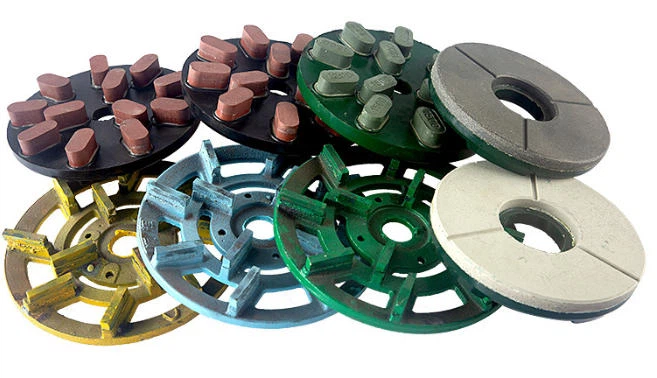
- Advantages: Compatible with most stone grinding machines; features rapid grinding speeds, excellent wear resistance, strong grit retention, high grinding efficiency, and low operational costs, making it an ideal tool for grinding applications.
- Disadvantages: Prone to causing surface chipping or "biting" of the stone, which creates complications for subsequent processing stages; the sequential numbering and management of the grinding discs for subsequent steps can be somewhat cumbersome.
2 Magnesite-Resin Abrasive Blocks
Magnesite-resin abrasive blocks are manufactured by casting and curing abrasive grains using magnesite, resin, and similar materials as binding and filling agents. They are widely utilized in automated stone processing lines and are also employed by numerous professional stone restoration companies.
These abrasive stones are categorized using two distinct numbering systems:
one based on mesh size and the other based on a sequential numerical index:
Mesh-based numbering: 36-mesh, 60-mesh, 120-mesh, 240-mesh, 400-mesh, 800-mesh, and Polishing Grade.
Numerical indexing: 1, 2, 3, 4, 5, and 0 (Polishing Grade).
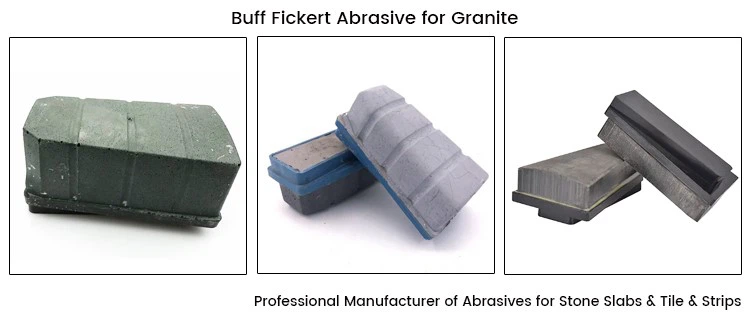
- Advantages: Delivers high-quality and consistent grinding results; offers excellent adaptability and strong process controllability; provides excellent value for money.
- Disadvantages: Domestic-manufactured abrasive stones-specifically the Polishing Grade (No. 0)-often suffer from inconsistent quality and poor polishing performance; conversely, imported abrasive stones (e.g., 5EX, 10LG) generally carry a relatively high price tag. However, thanks to advancements in domestic technology and the advantages of the supply chain, molds manufactured in China now offer greater cost-effectiveness.
3 Stone Renovation Pads and Wet Polishing Pads
Because their abrasive composition contains fine diamond powder, stone renovation pads and wet polishing pads are also referred to as "diamond polishing pads." We commonly distinguish between the two by labeling stone renovation pads as "hard pads" and wet polishing pads as "soft pads." (Wet polishing pads are widely utilized for the grinding and finishing of edges, corners, and irregularly shaped stone surfaces.) Due to their ease of transport and convenient usage, they are highly favored by the majority of stone renovation enterprises.
Their grit grading systems are categorized into two types: international standards and domestic standards:
International Grit Series: 30#, 50#, 100#, 200#, 400#, 800#, 1500#, 3000#
Domestic Grit Series: 30#, 50#, 150#, 300#, 500#, 1000#, 2000#, 3000#
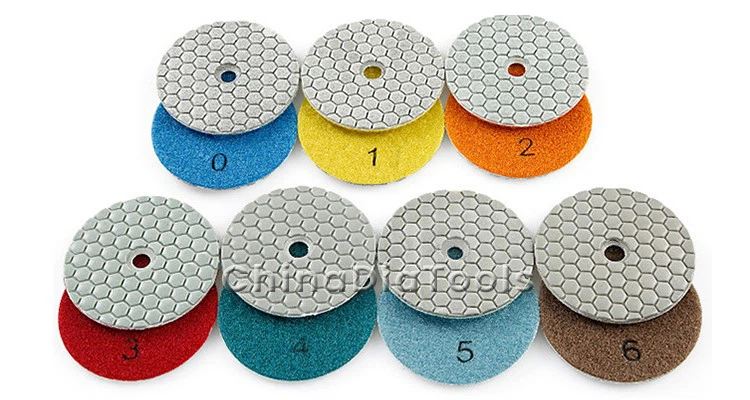
The final step in both series typically involves a "BUFF" pad (polishing pad), barring any specific custom requirements. As evident from the data above, the grit count of each subsequent step is generally double that of the preceding step; theoretically, this specific formulation design ensures that each successive pad effectively eliminates the scratches left by the previous one.
- Advantages: Highly practical and widely applicable; convenient to transport and use.
- Disadvantages: Subpar grinding and polishing performance; the surface of the stone tends to exhibit a "dry" appearance (characterized by fading or whitening) after grinding; high-quality versions of these products are expensive, resulting in a relatively low cost-performance ratio.
Overview
Beyond the selection of mechanical equipment, the choice of abrasives and grinding tools is equally critical; it directly impacts a company's output, revenue, and-consequently-individual earnings.
Therefore, selecting cost-effective abrasives and grinding tools can significantly reduce costs, boost output, and increase profitability. Opting for abrasives and tools developed and manufactured by Cheefung not only enhances the efficiency of stone processing but also effectively lowers costs and improves operational efficiency, thereby granting stone product manufacturers a distinct competitive edge in the marketplace.
Specifically, when leveling "lippage" (uneven edges) between stone slabs, it is advisable to use abrasives with high rigidity and rapid cutting capabilities-such as diamond grinding discs, magnesite or resin-bonded grinding stones (blocks), and specialized stone renovation pads.
We strongly advise against using flexible wet-grinding pads for this task. Due to their lack of rigidity, these pads tend to cause surface irregularities: on certain stone varieties (e.g., Caiyunfei or Tiannü Sanhua marble), they may create pitting or depressions; on others (e.g., Dahu Green marble), they may result in a "fish-scale" texture; and on terrazzo surfaces, they can lead to a "pebble-protrusion" effect. All these defects directly compromise the acceptance criteria for surface flatness, while also negatively impacting gloss levels, clarity, and the overall aesthetic and effectiveness of the grinding process.
Similarly, when removing surface scratches, one should utilize high-rigidity abrasives to ensure thorough and rapid scratch elimination; flexible pads, conversely, yield inferior results, work more slowly, and often leave residual scratches behind. Flexible pads are, however, suitable for the final polishing and buffing stages of stone surfaces-though it should be noted that the resulting degree of gloss and clarity will fall significantly short of the standards achievable with high-performance systems such as the 5EX or 10LG series.
Furthermore, different grinding subjects require the use of specific abrasives and tools. When our industry was in its infancy, our grinding subjects were limited; the vast majority consisted of marble, with only a small proportion being granite. Today, however, the scope has expanded dramatically: marble, granite, artificial stone, ceramics (including polished and vitrified tiles), microcrystalline stone, engineered stone composites, artificial quartz, terrazzo, concrete flooring, glass-is there any hard surface material that does *not* now fall within our purview for grinding and renovation?
Driven by societal progress, technological advancements, and improvements in the quality of life, we are confident that virtually all hard surface materials will eventually become subjects for our grinding and renovation expertise. The key to success lies in the judicious selection of the appropriate abrasives and grinding tools for each specific application. To cite a simple example: imagine the outcome if one were to use standard marble abrasives to grind microcrystalline stone. The inevitable result would be either an inability to grind the material at all, or the persistence of scratches that cannot be removed after the grinding process is complete. This failure stems from an incorrect selection of abrasives; specifically, the bonding agent is too strong, the abrasive tool is excessively hard, the abrasive grains fail to shed properly, lubrication is insufficient, new cutting edges cannot be effectively exposed, and the abrasive material lacks adequate self-sharpening properties-meaning the rate of grain shedding is fundamentally mismatched with the characteristics of the material being ground.