



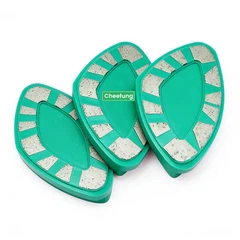

How to Select the Right Resin-Bonded Diamond Frankfurt Abrasive Blocks?
- When selecting Diamond Frankfurt abrasive blocks, you can evaluate options based on six key dimensions: stone compatibility, equipment dimensions, resin formula, grit size, diamond concentration, and customization for specific working conditions.
Comprehensive Selection Guide for Resin-Bonded Diamond Frankfurt Abrasive Blocks
This guide covers six core selection dimensions-ordered by the procurement decision-making process-including
- Stone compatibility,
- Equipment dimensions,
- Resin formula,
- Grit size,
- Diamond concentration,
- Customization.

(Cheefung Supply various type of Diamond Frankurt Abrasive)
I. Step One:
Matching the Polishing Machine Base Size(A mandatory requirement; incorrect sizing prevents installation)
1. Standard Universal T105 (T3 Horseshoe Style)
Dimensions: 106×95×40mm. Compatible with 90% of global automatic marble polishing lines (e.g., Keda, Breton, and Simec 8/12/16/20-head polishers). This is a mainstream stock item designed for direct replacement of OEM consumables.
2. Non-standard/Special Sizes
- T80 Small Horseshoe: For 8-head simple low-speed polishers and equipment used in small Southeast Asian workshops;
- Customized Extended/Thickened Bases: For European heavy-duty high-speed production lines and specially customized machine heads.
3. Abrasive Layer Thickness Selection
- 40mm Standard Layer: A cost-effective, general-purpose option; the top choice for small-to-medium factories and intermittent production;
- 45/50mm Thickened Wear-Resistant Layer: For 24-hour continuous mass production and hard marble or terrazzo; offers an 18%–25% increase in service life;
- 35mm Thin Abrasive Layer: For low-cost sampling and small-batch processing of thin slabs.
II. Step 2:
Select the resin formulation (hardness/softness) based on the stone type (a key factor determining the polishing result)
Resins fall into two main categories-hard general-purpose resins and soft, elastic resins-distinguished strictly by stone hardness and brittleness:
1 Hard Resin Formulation (General-Purpose)
- Suitable for: Standard beige, grey-white, and black marbles; terrazzo; and epoxy-repaired slabs.
- Advantages: High wear resistance, longer lifespan per pad, stable cutting action; ideal for large-scale processing of standard slabs.
- Drawbacks: Low flexibility; prone to leaving slight scratches when processing jade-like stones.
2 Soft, Elastic, Scratch-Resistant Resin (Specialized for Luxury Stones)
- Suitable for: Onyx, travertine, limestone, and porous, fragile, or translucent "soft" luxury stones.
- Advantages: Strong cushioning effect; prevents deep scratches and edge chipping; produces a uniform mirror-like gloss.
- Drawbacks: Lower wear resistance compared to hard resins; lifespan reduced by 10%–18%.
3 High-Wear-Resistance, Modified, Anti-Aging Resin
- Suitable for: 24-hour high-speed continuous production lines, conditions with insufficient cooling water, and hard marbles. Formulated with heat-resistant fillers to prevent powdering at high temperatures; lifespan increased by 15%–20%.

(Resin Bond Diamond Frankurt Abrasive for luxury stone)
III. Step 3:
Match the grit size to the specific polishing stage (use sequential progression; skipping grit sizes is strictly prohibited)
Resin Frankfurt pads are used only for medium polishing, fine polishing, and mirror finishing; they do not include coarse grinding grits. The complete grit range is: #120–#3000 plus Buff (high-gloss) pads.
1 Medium Polishing Grits: #120 / #180 / #240 / #400 / #600
- Purpose: Follows the transition grinding stage (magnesite pads); refines coarse grinding marks and unifies surface texture; features high material removal rates and faster wear.
- Applications: Slabs with visible residual marks; preliminary stage for fine processing of thick slabs.
2 Fine Polishing/Mirror Finish Grits: #800 / #1500 / #3000
- Applications: Initial gloss development, enhancing stone luster, and removing micro-scratches; low material removal rate with extended service life.
3 Buff Polishing Block (Finishing)
- Applications: Ultra-high gloss mirror finish (achieving 90–105° gloss units); designed for high-end countertops and decorative stone; premium pricing compared to standard grits.
Standard Marble Grinding Sequence
- Metal Bond Diamond Frankfurt Abrasive #36–#120 (Coarse Grinding) →
- Magnesite Frankurt Abrasive #240–#400 (Transition) →
- Resin Bond Diamond Frankfurt #600–#1500–#3000 →
- Buff
IV. Step 4:
Matching Diamond Concentration to Factory Production Conditions
Industry Standard Concentrations: 75% / 100% / 125%
1. 75% Low Concentration
- Suitable for: Small workshops, intermittent production, and thin or soft marble slabs; features rapid self-sharpening and smooth polishing action, though individual pad lifespan is shorter; ideal choice for low-budget trial runs.
2. 100% Standard Concentration (Used by 90% of factories)
- Balances sharpness and wear resistance; offers the best overall cost-performance ratio; the standard choice for general stone processing plants.
3. 125% High Concentration (Wear-Resistant)
- Suitable for: 24-hour continuous mass production, hard marble, and terrazzo; high diamond content reduces tool replacement frequency by half, minimizing downtime.

(Diamond Frankfurt Abrasive Tools package)
Our company provides customized packaging and labeling services for users. Can quickly promote customer brands
V. Step 5:
Precision Selection Based on Factory Production Conditions
Scenario 1:
Large-scale marble plant with 24-hour continuous production (high-speed conveyor belts, processing various slab patterns)
- Recommended Configuration: T105 45mm thickened abrasive layer + aging-resistant hard resin + 100%–125% diamond concentration;
- Benefits: Stable wear resistance, reduced downtime for tool replacement, and suitability for continuous, high-temperature processing around the clock.
Scenario 2:
Medium-to-large comprehensive stone processing plant (standard marble, engineered slabs, 8-hour intermittent production)
- Recommended Configuration: T105 40mm standard layer + general-purpose hard resin + 100% standard concentration;
- Benefits: Balances procurement costs with service life; suitable for the vast majority of conventional marble types.
Scenario 3:
High-end luxury stone processing plant (focus on Onyx, travertine, and translucent stone)
- Recommended Configuration: T105 standard layer + customized soft/elastic resin formula;
- Benefits: Gentle polishing; prevents scratches and edge chipping; ensures high yield rates for premium finished stone products.
Scenario 4:
Small workshop / Sample procurement (low-speed 8-head machines, limited budget)
- Recommended Configuration: T105 40mm standard hard resin + 75% diamond concentration;
- Benefits: Lower unit price; meets basic polishing needs; ideal for small-batch trial production.
Critical Operational Restrictions
- Insufficient cooling water or dry grinding due to water interruption: Choose the thickened, aging-resistant version; standard resin will easily disintegrate into powder and fail due to high heat;
- Excessive head pressure or overly fast slab feed speed: Avoid low-concentration soft resin; wear rates will double;
- Using resin blocks for rough grinding of raw blocks: Ineffective cutting; wears out extremely fast and fails to flatten the surface.
VI. Step 6:
Customization and Ancillary Needs
- OEM/Private Labeling: Printing client brand logos and custom color-box packaging;
- Customized Formulas: Adjusting resin hardness for specific stone types (e.g., Turkish or Italian marble);
- Complete Set Solutions: Available for one-stop procurement alongside metal-bond and magnesite-bond Frankfurt abrasives;
- Small-batch Sampling: Test stone compatibility with a small quantity of standard models before placing bulk orders.

(Resin Diamond Frankfurt Abrasive Grinding block laser marking site)
We are providing laser marking services for user products.
VII. Common Selection Errors & Pitfalls to Avoid
- Using resin abrasives for jade processing: Results in irreversible micro-scratches after polishing, leading to high rework costs.
- Using standard, low-concentration resin abrasives with thin grinding layers on high-speed, 24-hour production lines: Frequent abrasive block replacements cause significant downtime losses.
- Skipping intermediate grit sizes and jumping straight to #3000: Leaves deep residual marks, making it impossible to achieve a uniform mirror-like finish.
- Using resin Frankfurt blocks instead of metal blocks for the initial rough grinding of thick slabs: Insufficient cutting force causes a drastic drop in production efficiency.
By following the steps above, most users can successfully select high-quality resin Frankfurt abrasive blocks. If you still have questions, please contact cheefung; with years of R&D and manufacturing experience, we provide premium resin Frankfurt blocks and offer customization options to meet specific user requirements. Our coarse-grit resin bond diamond fickert/frankfurt blocks offer aggressive cutting and long service life, while our fine-grit resin bond diamond fickert/frankfurt blocks enable rapid polishing-easily achieving and maintaining a gloss level of 100. We offer stable performance, factory-direct pricing, and excellent value.